ITAM
What is GLPI? Definition + 2026 Use Cases
GLPI explained for IT admins: definition, versions 11.0 vs 10.0, governance, real pricing, and when to migrate to modern SaaS alternatives.
16 min read
Citation capsule
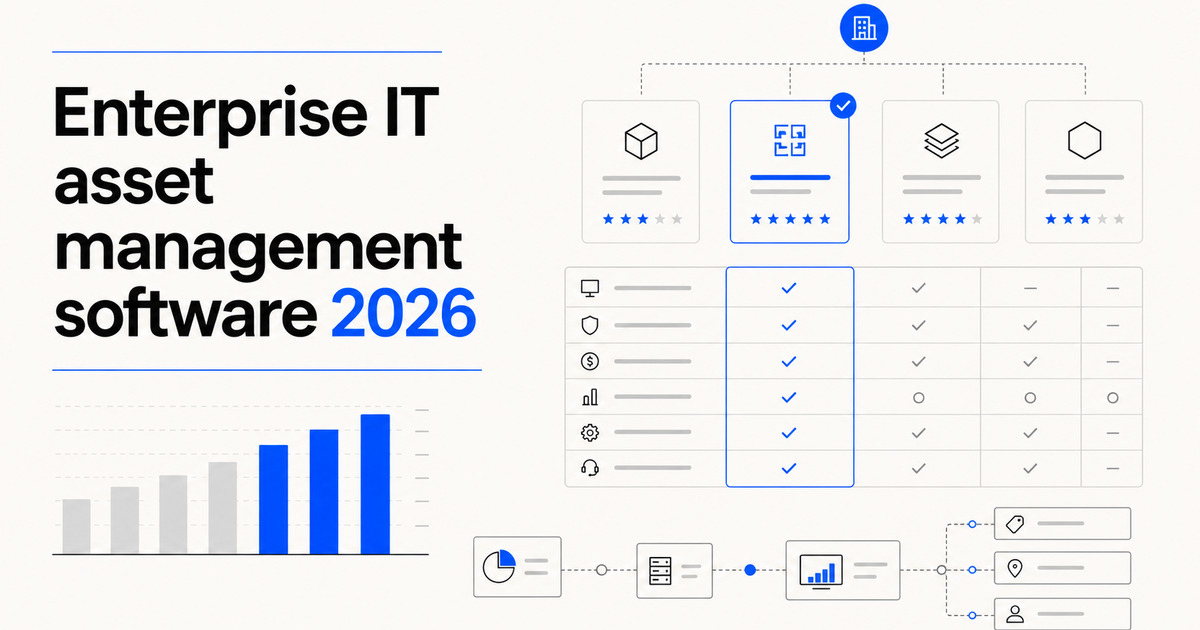
Enterprise IT asset management software covers a different problem than mid-market ITAM. The buyer is a CIO, a procurement director, or a CFO answering to ISO 27001, NIS2, and CSRD ESRS E1. The stack already has 30+ tools. The question isn't "which agent has the prettiest UI" — it's "which tool produces an audit-defensible CMDB and a CSRD-ready CO₂ report without doubling the agent count on every device."
This list compares 10 enterprise-grade ITAM platforms on the metrics that actually matter for a 5,000+ device fleet. Pricing is verified against vendor pages and reseller surveys as of May 2026. For the broader ITAM landscape see our IT asset management software pillar, the IT asset management reference, the GLPI alternative SaaS, the GLPI Agent guide, and the IT carbon footprint enterprise guide.
Three things distinguish enterprise ITAM from mid-market.
First, scope. Enterprise ITAM covers hardware (endpoints + datacenter + mobile + IoT), software licensing (SAM), SaaS spend (SMP), and sustainability reporting (ESRS E1, Scope 3 Category 1 + 2). Single-purpose tools force integration overhead.
Second, compliance. ISO 27001 inventory clauses, NIS2 asset-register mandate (October 2024 deadline), and CSRD reporting (~50,000 EU companies in scope, first filings 2026) push ITAM from "nice to have" to "regulatory prerequisite."
Third, scale. Enterprise deals price by fulfiller user (ServiceNow), license value (Flexera), or asset count with custom quotes above 10,000 (Lansweeper Enterprise). Per-device list pricing is rare past mid-market.
Each vendor below is rated on six criteria:
| Criterion | What it measures |
|---|---|
| CMDB depth | Discovery + relationship mapping (apps to servers to dependencies) |
| SAM depth | License entitlement vs consumption reconciliation (Microsoft, Oracle, SAP, IBM) |
| Agent footprint | Number of agents per device, measured CPU/RAM impact |
| CSRD readiness | Per-device measured CO₂ output, ESRS E1 export, Scope 3 Cat 1/2 split |
| Public-sector fit | FR/EN bilingual, sovereign hosting, public-tender form factor |
| Pricing transparency | Public per-unit pricing vs custom quote |
ServiceNow ITAM bundles with ServiceNow ITSM Professional/Enterprise tiers — most enterprises don't buy ITAM standalone, they extend ITSM. Pricing is per-fulfiller-user per-month:
The ITAM module adds Hardware Asset Management, Software Asset Management, and Cloud Insights — typically a 30–50% uplift on the ITSM seat price. ServiceNow's strength is the CMDB and the discovery engine (formerly known as Discovery + Service Mapping). The weakness is cost — enterprise deals routinely land $500k–$2M/year, and customization eats integrator hours.
Pick ServiceNow if you already run ITSM on it and want a single platform of record. Skip if your CMDB is a brownfield and discovery is your primary pain.
Flexera completed its acquisition of Snow Software in February 2024. Snow Atlas is no longer a competitor — it's now positioned as Flexera's mid-market SAM line, while the Flexera One platform handles enterprise SAM, FinOps, and Technology Intelligence.
Flexera's strength is software license reconciliation against complex vendor models — Microsoft, Oracle Database, IBM PVU/RVU, SAP HANA. The IT Visibility data lake (Technopedia-backed) is the deepest software taxonomy on the market. Pricing is custom, typically tied to license-value-under-management.
Pick Flexera if your software audit risk dwarfs your hardware lifecycle pain — Oracle and IBM contracts make this the default.
IBM ILMT is free under IBM's PVU/RVU subscription terms — but it's not optional. Running IBM middleware (WebSphere, DB2, MQ) without ILMT exposes you to full-capacity license claims on every CPU your IBM software touches. ILMT lets you claim subcapacity (per-VM) licensing instead — the financial gap is often 5-10× the license cost.
Pick ILMT alongside any IBM stack — it's a compliance prerequisite, not a buying choice. Pair it with Flexera or another ITAM for non-IBM software.
Still listed separately in many RFPs. Snow Atlas focuses on SaaS spend management and software usage analytics. Cloud-native, lighter onboarding than Flexera One. Pricing remains custom.
Lansweeper's Enterprise tier starts at 10,000 assets and scales in 2,000-asset increments. Pricing is custom — public list is Starter (€199/mo, 2,000 assets) and Pro (€359/mo base, 2,000 assets). Enterprise quotes typically land $50k–$150k/year for 10,000–25,000 assets.
Strength: agentless WMI/SSH/SNMP discovery covers what other tools miss (IoT, OT, network gear). Weakness: software license depth is shallow vs Flexera, and CSRD/CO₂ reporting is not native — you ship the inventory to a third-party carbon tool.
Pick Lansweeper if the brownfield network is your problem — discovery first, license management second.
BMC Helix Discovery (formerly TrueSight Discovery, formerly ADDM) competes head-to-head with ServiceNow Discovery on CMDB enrichment. Agentless, runs from a single appliance, deep relationship mapping for application dependencies. Pricing is custom, often lower than ServiceNow at the same scale.
Pick BMC Helix Discovery if you need CMDB depth but don't run ServiceNow ITSM — or if your CMDB is BMC Remedy.
Ivanti Neurons combines ITAM with endpoint management, patch, and zero-trust access in one platform. Strength: a single agent for ITAM + EDR + patch. Weakness: post-2024 security incidents created enterprise caution — vet the security posture carefully.
If your fleet is Windows + Microsoft 365, Endpoint Manager covers Windows inventory natively and integrates with Entra ID for compliance. It's not a full ITAM (no license reconciliation, no CSRD), but it's bundled. Many enterprises run Endpoint Manager for endpoint inventory and add a SAM tool (Flexera, Snow) on top.
ManageEngine fits the value-engineering end of enterprise ITAM — published per-device pricing, faster onboarding than ServiceNow, multi-vendor discovery (WMI, SNMP, SSH). Used heavily in EMEA mid-large enterprise. Limit: software license depth is workable, not exceptional.
sobrii is the European-built ITAM SaaS that ships inventory, per-app energy measurement, zombie-app detection, and WebRTC remote desktop in one Rust agent — designed for the CSRD + NIS2 combo and 100% bilingual FR/EN at the core. Public reference: the Métropole de Montpellier and Hérault Logement deploy sobrii across a fleet of around 7,500 endpoints (project documented by the BIC de Montpellier). The initiative cuts hardware purchases and the fleet's carbon footprint.
Pricing is per-device, transparent on the website. The wedge is structural — not "another inventory tool" but the only platform that produces a CSRD-ready ESRS E1 CO₂ report and a NIS2 asset register from the same measured data.
One Rust agent, < 1% CPU. The enterprise ITAM industry average stacks an inventory agent (Lansweeper or ServiceNow Discovery), an MDM (Intune), an EDR (CrowdStrike), an RMM (Atera), and a DEX tool (ControlUp). sobrii ships one signed, sandboxed Rust binary with a measured footprint < 1% CPU on Windows and macOS. Fewer agents = smaller attack surface, less battery drain, less support overhead.
For a 5,000-device fleet, that's roughly 25,000 endpoint agents removed from the security review. The NIS2 asset register is generated from sobrii's own data — no cross-tool reconciliation needed.
See how the single sobrii Rust agent covers the same scope as 5 enterprise tools.
sobrii measures kWh per employee, not per site. The Rust agent captures real consumption (CPU/GPU/screen/battery) second-by-second, then applies the regional grid emission factor (ADEME, RTE for France; Ember/EPA eGRID elsewhere) to produce kg-CO₂/employee/month — exportable directly to CSRD ESRS E1.
CSRD ESRS E1 disclosure is required for ~50,000 EU companies, with first filings due in 2026 on FY2025 data. The recurring assurance findings on early reports — no measurement traceability, stale emission factors, Cat 1 vs Cat 2 misallocation — all stem from estimation-based reporting. Tools that produce per-device CSVs with timestamped exports cut audit prep from weeks to hours.
ServiceNow, Flexera, and Lansweeper don't natively measure energy consumption — they list hardware. To produce a CSRD report, you cross their inventory with a third-party carbon estimator (often based on category averages, not measurement). sobrii rolls the measurement → emission factor → ESRS export chain into one pipeline.
sobrii attributes kWh per application. For each process (Chrome, Teams, Photoshop, Slack), sobrii measures CPU + GPU time and reconstructs real power draw. You learn that Teams consumes 3.2 kWh/yr/device and Chrome 5.1 — a measurement Flexera and ServiceNow don't expose.
Why this matters for enterprise: per-app energy gives you both a CO₂ allocation lever (which apps drive the footprint) and a procurement lever (do we need this third Slack tier given consumption + crash rate). It turns the SAM conversation from license reconciliation into a measurable consumption decision.
sobrii surfaces zombie apps and per-app crash rate. A 'zombie app' = installed on ≥ 30% of the fleet, used by < 5% of employees. sobrii lists them with annual license waste. Same for crash rate: sobrii knows app X crashes 2.4×/day on Dell Latitude 5420s, 0.1× on M2 MacBook Pros — actionable DEX, not a Net Promoter score.
For enterprise SAM, zombie-app detection alone justifies the contract. Adobe Acrobat Pro at 312 unused seats × $23.99/month = $89,790/year recovered (one customer's identified spend in their first quarterly review). ServiceNow and Flexera need third-party DEX tools (ControlUp, Nexthink) to produce this insight.
sobrii adds a 4th lifecycle decision: reallocate. Where ServiceNow, Flexera, and Lansweeper expose 3 paths (keep / repair / replace), sobrii computes 4 options per device — upgrade, repair, reallocate (to the next employee), replace — with cost and CO₂ for each. The reallocate branch extends average service life by 12-18 months and halves per-device embodied carbon.
Reallocation is where the enterprise carbon math wins. For a typical knowledge-worker laptop, 60-80% of lifetime CO₂ is embodied at manufacturing. Stretching service life from 3 years to 5 cuts annualized carbon by ~40%. The 4th decision isn't a feature — it's the difference between estimating CSRD numbers and reducing them.
Remote control is in the plan, not an add-on. No need to buy TeamViewer or AnyDesk on top: sobrii ships a built-in WebRTC remote-desktop module (peer-to-peer, no external relay, multi-screen, auto-reconnect). 200-device benchmark: TeamViewer Business fully-loaded median spend ≈ $1,020/month → sobrii: $0/month (bundled).
For enterprise, the structural win is fewer vendor contracts and one less attack-surface tool (TeamViewer's 2024 SVR intrusion remains in many CISO memos).
sobrii is 100% bilingual FR/EN at the product core. Every label, every CSRD/ISO 27001 report, every export is rendered in the user's language — not a 70%-translated glossary. Public reference: the Métropole de Montpellier and Hérault Logement run sobrii across a fleet of around 7,500 endpoints (project documented by the BIC de Montpellier). sobrii is one of the rare ITAM SaaS designed in France with FR/EN parity from v1.
For EU public-sector tenders (and the French Loi REEN compliance for réduction de l'empreinte environnementale du numérique), bilingual parity is a tender-mandatory criterion that most US-built ITAM products fail on documentation alone.
| Primary pain | Pick |
|---|---|
| Already run ServiceNow ITSM, want one platform | ServiceNow ITAM |
| Oracle/SAP/IBM license risk is the biggest exposure | Flexera + IBM ILMT |
| Brownfield network, IoT, OT — need discovery first | Lansweeper Enterprise |
| Windows-heavy + Microsoft 365 fleet | Endpoint Manager + Flexera (SAM) |
| CSRD ESRS E1 + NIS2 + want to cut agent count | sobrii |
| EU public-sector tender, bilingual mandatory | sobrii |
| BMC Remedy CMDB legacy | BMC Helix Discovery |
The IT asset management software market reached USD 5.04 billion in 2026, growing from USD 4.66 billion in 2025 at 8.0% CAGR per Precedence Research. The broader enterprise asset management (EAM) market is USD 6.26-6.6 billion. Growth drivers: CSRD reporting, NIS2 asset register mandates, SaaS spend management, and FinOps convergence.
ServiceNow doesn't publish device pricing — pricing is per fulfiller user per month. ITSM Standard is $70–$100/user/month, Professional $120–$150, Enterprise $160–$200+. ITAM is a module that adds 30–50% to the ITSM seat. For a 5,000-device deployment with 50 fulfillers, total spend is typically $500k–$1.2M/year.
IBM ILMT is free under IBM's PVU/RVU subscription terms but mandatory for subcapacity licensing claims. Running IBM middleware (WebSphere, DB2, MQ) without ILMT exposes the customer to full-capacity license claims on every CPU touched — typically 5-10× the subcapacity cost. ILMT is therefore a compliance prerequisite, not a buying choice.
Yes. Flexera completed the acquisition of Snow Software on February 15, 2024. Snow Atlas is now part of the Flexera portfolio — the two are no longer competitors. Flexera One handles enterprise SAM + FinOps; Snow Atlas focuses on mid-market SaaS spend management.
CSRD (Corporate Sustainability Reporting Directive) requires ESRS E1 climate-disclosure for ~50,000 EU companies. First filings are due in 2026 on FY2025 data. ESRS E1 mandates Scope 1, 2, and 3 emissions reporting — for IT fleets, this means per-device measured energy and embodied carbon, not category averages. ITAM tools that don't natively produce per-device CO₂ exports force a third-party carbon estimator in the audit chain.
sobrii ships one Rust agent measured at < 1% CPU continuously on Windows and macOS. The market average for enterprise ITAM stacks 3-5 agents per device (inventory + MDM + EDR + RMM + DEX). For a 5,000-device fleet, consolidating to one agent removes roughly 20,000 endpoint installations from the security review.
Both, depending on vendor. ServiceNow prices per fulfiller user/month. Flexera ties pricing to license-value-under-management. Lansweeper prices per asset (tiered). sobrii prices per device. For multi-vendor comparisons, normalize to per-device-per-year and add expected fulfiller seats separately — most enterprise deals mix both dimensions.
Discover how sobrii transforms IT fleet management.
Book a demo