ITAM
What is GLPI? Definition + 2026 Use Cases
GLPI explained for IT admins: definition, versions 11.0 vs 10.0, governance, real pricing, and when to migrate to modern SaaS alternatives.
16 min read
Citation capsule
Digital Employee Experience (DEX) is the measurable quality of every IT interaction an employee has — from device boot to app crash to remote-meeting drop. The category is no longer optional in hybrid work. With 60% of mid-market employees working two or more days remotely (Gartner 2025), the IT team cannot rely on physical desk visits to diagnose problems.
DEX matters because every silent IT degradation translates into lost focus time. A laptop that boots in 90 seconds instead of 25 seconds costs the employee 5+ minutes per workday — 20 hours per year. Multiply by 500 employees: 10,000 hours of lost productivity. That's the economics behind the DEX category's growth.
This guide defines DEX, breaks down the four measurable signals, maps the six-vendor landscape, and explains why sobrii treats DEX as an ITAM module rather than a standalone platform.
For broader IT asset management context, see our IT asset management guide.
DEX is the discipline of measuring and improving the digital quality of every employee's daily work — device performance, app stability, network reliability, and the tools they use. The category emerged in 2018-2019 (Nexthink, Lakeside, 1E) as a counter-trend to traditional endpoint monitoring focused on infrastructure, not user reality.
The Gartner definition (2024): "DEX management tools provide visibility, sentiment, and engagement scores across an employee's digital workplace." In practice, the discipline rests on four objective signals — not subjective sentiment surveys.
Three structural forces drove DEX from niche to mainstream:
Hybrid work. IT teams lost the ability to walk to a desk. Remote diagnosis is now mandatory.
Cost transparency. CFOs want to know whether the laptop they spec'd for $1,400 actually delivers value. DEX signals make device productivity measurable.
Hardware sustainability. Green IT teams need to know which devices and apps consume disproportionate energy. DEX is the only way to attribute kWh per process.
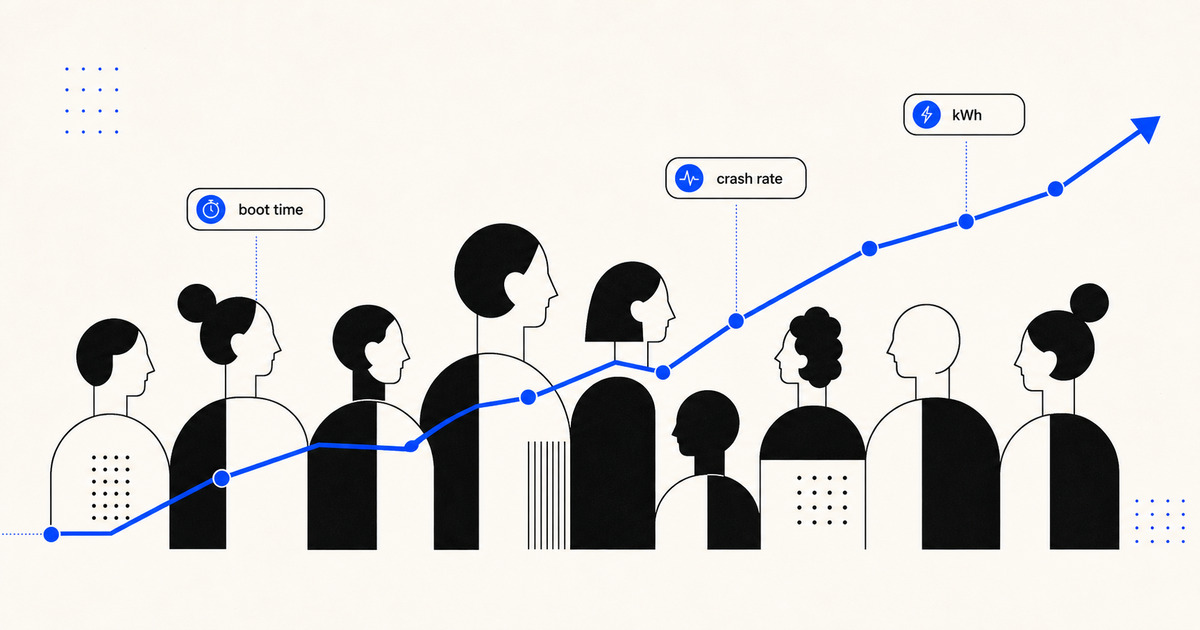
DEX is not a sentiment survey. The category split between "sentiment-based" (Microsoft Viva) and "telemetry-based" (Nexthink, Lakeside, 1E, ControlUp, sobrii) is now settled — telemetry wins. Four signals matter.
Boot time, sequence profile, login duration. The benchmark for 2026 corporate laptops: cold boot < 30 seconds, post-login app readiness < 90 seconds. Anything slower indicates SSD wear, OS bloat, or startup app overload.
A device booting 60 seconds slower than baseline costs 4 minutes/day. Across a 500-device fleet, that's 16,500 lost hours per year — measurable in support tickets and lost focus time.
The continuous period during which an employee is uninterrupted by app crashes, reboots, or modal dialogs. Microsoft Viva tracks calendar-based focus time; telemetry-based DEX tracks actual focus time at the OS level — much more accurate.
Average corporate employee focus time in 2025 (Microsoft Work Trend Index): 77 minutes/day, against 4.2 hours of meetings. DEX tools measure whether IT is helping or hurting that 77-minute floor.
How many times does Chrome crash on this device this week? Per app, per device model, per OS version. This is the signal that separates real DEX from monitoring. ControlUp pioneered it; Nexthink and Lakeside followed; sobrii captures it natively.
Typical fleet finding: Teams crashes 2.4× per week on Dell Latitude 5420 with Windows 10 22H2, but 0.1× on M2 MacBook Pros. That's a specific, actionable diagnostic.
The 2026 wedge. With CSRD ESRS E1 reporting mandatory for European mid-market since 2024, IT must produce a credible per-employee kg-CO₂ number. The only way to do this honestly is to measure kWh at the device level, then at the app level — not estimate by category average.
Nexthink and Lakeside expose total device energy. Only sobrii exposes per-app kWh in the standard tier.
Eight serious DEX platforms exist in 2026, split between telemetry-driven and sentiment-driven approaches. This section compares all eight on six dimensions: telemetry depth, pricing, agent footprint, ITAM integration, Green IT/energy attribution, and bilingual product surface.
| # | Platform | Type | Public price | Agent footprint | Per-app kWh | ITAM bundled | FR/EN parity |
|---|---|---|---|---|---|---|---|
| 1 | Nexthink | Telemetry | Custom (~€40-60/dev/yr) | 80-120 MB RAM | No | No | Partial |
| 2 | Lakeside SysTrack | Telemetry | Custom (~€35-50/dev/yr) | 120-180 MB RAM | No | Light | Partial |
| 3 | 1E (Tachyon) | Telemetry + actions | Custom (~€30-50/dev/yr) | 60-100 MB RAM | No | No | Partial |
| 4 | ControlUp | Telemetry (VDI strength) | From $9/dev/mo | 50-90 MB RAM | No | No | English-first |
| 5 | Riverbed Aternity | Telemetry (APM strength) | Custom | 100-140 MB RAM | No | No | English-first |
| 6 | sobrii | Telemetry + ITAM | On request (per device, all-inclusive) | < 30 MB RAM, < 1% CPU | Yes | Yes | Native bilingual |
| 7 | Microsoft Viva Insights | Sentiment | Bundled in M365 E5 (~$57/user/mo) | 0 (cloud-only) | No | No | Yes |
| 8 | Almaden Collective IQ | Sentiment | Custom | Light agent | No | No | English-first |
Source: vendor pricing pages, Gartner DEX MQ 2025, Vendr public benchmarks.
Founded: 2004, Lausanne. Customers: 1,200+ enterprises.
Nexthink dominates the DEX category by sheer install base. Its strengths: deep telemetry-sentiment correlation, mature investigations workspace, the longest catalog of "experience packs" (pre-built remediation scripts). Its agent (Nexthink Collector) averages 80-120 MB RAM idle.
Best for: Fleets over 5,000 devices with a dedicated DEX analyst on staff. Implementation typically requires 6-12 months and an integration partner — budget €100k+ year one.
Skip if: Fleet under 1,000 devices. Nexthink's pricing model doesn't suit mid-market.
Founded: 1997, Boston. Now part of: Smart Global Holdings (since 2023).
Lakeside's differentiator: 90 days of full per-device telemetry retained, vs. Nexthink's 30 days standard. This depth enables long-tail diagnostics (find the device whose Chrome crashed weekly for 60 days). Trade-off: agent is heavier (120-180 MB RAM).
Best for: Mature IT analytics teams who need historical depth for capacity planning and root-cause investigations.
Skip if: You can't afford the agent footprint or the implementation services overhead.
Founded: 1997, London. Rebrand: Mondo Recently (2024).
1E's wedge: real-time scripting. Push a remediation across 50,000 devices in seconds. The DEX angle is bolted onto a legacy systems-management product. Strength: incident resolution speed. Weakness: less historical analytics than Lakeside; agent capabilities can be misused (full system access by design).
Best for: Organizations where MTTR (mean time to remediate) is the bottleneck and IT operations is centralized.
Founded: 2012, Israel. Strength: Citrix and VMware Horizon environments.
ControlUp built its product on session-quality monitoring for VDI before expanding to physical endpoints. Best-in-class for VDI heritage, including XenApp, Horizon, AVD (Azure Virtual Desktop). Public price from $9/device/month per Vendr benchmarks.
Best for: Fleets with heavy VDI/published-apps deployment (financial services, healthcare, regulated industries).
Skip if: Your fleet is purely physical endpoints — Nexthink or Lakeside have more depth there.
Founded: 2014 (Aternity acquired by Riverbed in 2017).
Riverbed treats applications as the unit of analysis: which app is slow, on which device, for which user. Strength: correlation between application performance monitoring (APM) and DEX. Weakness: heaviest enterprise sales cycle of the eight; pricing opaque.
Best for: Organizations where APM + DEX correlation matters more than ITAM context.
Founded: 2023, France. Public reference: Métropole de Montpellier and Hérault Logement are deploying sobrii across a fleet of ~7,500 devices (project documented by the BIC de Montpellier). The initiative cuts hardware purchases and the fleet's carbon footprint.
Different positioning entirely. sobrii is an ITAM platform that ships DEX signals as one module of 13 — boot, focus time, crash rate, per-app energy, zombie apps, employee CO₂. No separate license, no separate agent. The Rust agent runs at < 1% CPU and < 30 MB RAM continuous.
The structural difference vs. the other seven: DEX is included in the ITAM plan at no extra cost, comparable to ITAM-only pricing from Lansweeper or GLPI Network. And sobrii is the only platform that exposes per-app kWh natively.
Best for: Mid-market fleets (50-5,000 devices) that want DEX, ITAM, and Green IT in one product, with native FR/EN parity.
Bundled in: Microsoft 365 E5 (~$57/user/month).
Viva measures calendar-based focus time, after-hours work, and collaboration patterns from Microsoft Graph signals. It is not a telemetry-based DEX platform. Gartner's 2025 DEX Magic Quadrant excludes Viva.
Best for: Organizations that want collaboration analytics alongside their telemetry DEX tool. Not a replacement for Nexthink/Lakeside/sobrii.
Founded: Brazil-based, growing in LATAM and North America.
Almaden combines sentiment surveys with light telemetry. Strength: regional presence in Latin America. Weakness: smaller catalog of integrations, less mature than the top six.
Best for: Regional plays in LATAM. Globally less competitive vs. Nexthink or sobrii.
sobrii surfaces zombie apps and per-app crash rate. A 'zombie app' = installed on ≥ 30% of the fleet, used by < 5% of employees. sobrii lists them with annual license waste. Same for crash rate: sobrii knows app X crashes 2.4×/day on Dell Latitude 5420s, 0.1× on M2 MacBook Pros — actionable DEX, not a Net Promoter score.
The reason zombie apps matter: a 500-device fleet typically has 8-15 zombie apps. Adobe Acrobat Pro at $23.99/user/month × 312 unused seats = USD 89,800/yr recoverable license waste. That's the DEX signal nobody else exposes.
For the depreciation calculus behind license recovery, see our IT asset management guide.
sobrii attributes kWh per application. For each process (Chrome, Teams, Photoshop, Slack…), sobrii measures CPU + GPU time and reconstructs real power draw. You learn that Teams consumes 3.2 kWh/yr/device and Chrome 5.1 — a measurement GLPI and Lansweeper don't expose, and Nexthink only exposes at the device level.
This signal feeds two reports: Green IT consumption ranking (which apps to optimize first) and CSRD ESRS E1 scope 3 attribution (energy by service line).
One Rust agent, < 1% CPU. The industry average stacks an inventory agent (GLPI), an MDM (Intune), an EDR (CrowdStrike), an RMM (Atera), and a DEX tool (ControlUp). sobrii ships one signed, sandboxed Rust binary with a measured footprint < 1% CPU on Windows and macOS. Fewer agents = smaller attack surface, less battery drain, less support overhead.
Nexthink's agent averages 80-120 MB RAM idle; Lakeside's around 150 MB. sobrii's Rust agent stays under 30 MB RAM continuous and < 1% CPU even during full telemetry collection.
Five criteria separate signal from noise:
sobrii passes all five. Nexthink, Lakeside, 1E pass 1, 3, 4 (not 2, not 5 natively). ControlUp passes 1, 3 (not 2, partial 4 + 5). Riverbed passes 1, 4 (not 2, not 5 natively).
DEX is the measurable quality of every IT interaction an employee has — device boot, app stability, network reliability, energy footprint. The 2026 metric stack relies on four telemetry signals (boot performance, focus time, per-app crash rate, per-app energy), not subjective sentiment surveys. Tools like Nexthink, Lakeside, 1E, ControlUp, Riverbed Aternity, and sobrii dominate the category.
Traditional endpoint monitoring focuses on infrastructure health (CPU, RAM, disk) — what IT sees. DEX focuses on user-experienced quality — what the employee actually feels: app crashes, boot delays, focus interruptions. DEX subsumes monitoring but adds per-app behavior, focus time, and increasingly energy attribution.
Nexthink, Lakeside, 1E and Riverbed all use custom quotes, typically €30-60/device/year for mid-market deployments. ControlUp starts around $9/device/month (~$108/device/year) for VDI use cases. sobrii bundles DEX in its all-inclusive ITAM plan (no separate DEX license). Implementation services for the four enterprise vendors often double year-1 spend.
Partially. Microsoft Viva Insights (formerly Workplace Analytics) measures calendar-based focus time and collaboration patterns, not OS-level telemetry. It is a sentiment + collaboration analytics tool, not a telemetry-based DEX platform. Gartner's 2025 DEX Magic Quadrant excludes Viva. For boot, crash, and energy signals, Viva is insufficient — pair it with a telemetry tool.
Nexthink, Lakeside, 1E and Riverbed all use custom quotes, typically €30-60/device/year for mid-market deployments. ControlUp starts around $9/device/month (~$108/device/year) for VDI use cases. sobrii bundles DEX in its all-inclusive ITAM plan (no separate DEX license). Implementation services for the four enterprise vendors often double year-1 spend.
sobrii's Rust agent at < 30 MB RAM idle and < 1% CPU. The category average is 80-150 MB RAM (C++ or .NET agents from Nexthink, Lakeside, 1E, Riverbed). ControlUp is mid-pack at 50-90 MB. Light agents matter for two reasons: battery life on laptops (Green IT) and not aggravating the DEX problem you're trying to solve.
Not as of the 2025 Magic Quadrant. sobrii's positioning as ITAM + DEX combined doesn't map cleanly to Gartner's pure-DEX taxonomy. For 2026 the Gartner Magic Quadrant DEX Leaders are Nexthink, Lakeside, 1E, and Riverbed. Challengers and Visionaries include ControlUp, IBM, Microsoft Viva.
Telemetry-based platforms outperform sentiment-only for hybrid work because the IT team can't visit the desk. Nexthink and Lakeside have the deepest remote-diagnostics workflows; sobrii adds remote-control natively (no TeamViewer/AnyDesk dependency, see sobrii Remote). Skip Viva-only if hybrid: it doesn't capture the right signals.
Not entirely, but it shifts the curve. Nexthink reports 28% ticket reduction at enterprise customers after deploying DEX (proactive remediation before users notice). The remaining tickets are higher-quality — pre-diagnosed by DEX signals, faster to resolve. ROI compounds with fleet size.
Because the data overlap is 80%+. Inventory telemetry (hardware, software, OS) and DEX telemetry (boot, crash, energy) come from the same Rust agent. Customers paying for separate ITAM + DEX agents are paying twice for the same collection. sobrii bundles them in one all-inclusive ITAM plan, competitive with ITAM-only pricing from Lansweeper or GLPI Network — DEX comes free.
Discover how sobrii transforms IT fleet management.
Book a demo