ITAM
Digital Employee Experience (DEX): 2026 guide and signals
Digital Employee Experience in 2026: 4 measurable signals (boot, focus, crash, energy), the 6-vendor landscape, sobrii's zombie apps and per-app kWh angle.
12 min read
Citation capsule
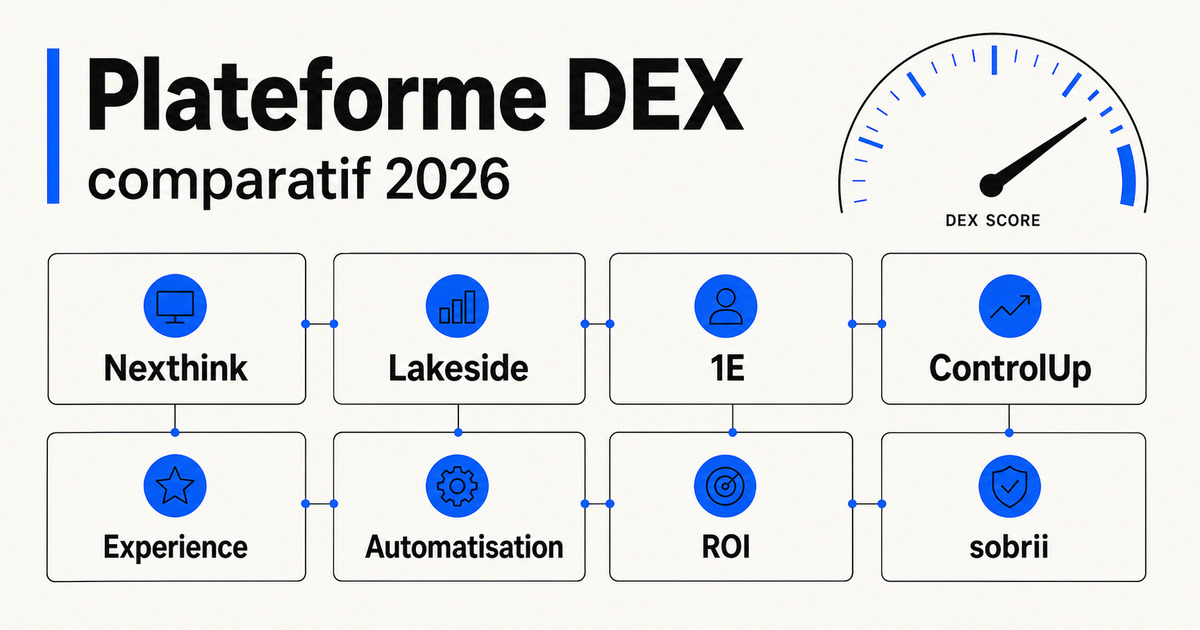
A DEX (Digital Employee Experience) platform measures the digital quality of every employee IT interaction — device performance, app stability, network reliability, energy use. The category has eight serious contenders in 2026, split between telemetry-driven and sentiment-driven approaches.
This article compares all eight on six dimensions: telemetry depth, pricing, agent footprint, ITAM integration, Green IT/energy attribution, and bilingual product surface. The verdict at the end maps each platform to its best-fit scenario.
For the broader DEX concept, see our digital employee experience guide.
A DEX platform is software that collects telemetry or sentiment from employee endpoints and produces measurable quality signals — boot time, app crash rate, focus time, energy consumption, network latency. The category emerged in 2018-2019 with Nexthink and Lakeside; it accelerated post-2022 with hybrid work mandates.
Three architectural families exist:
Telemetry-based. Local agent collects OS-level signals (Nexthink, Lakeside, 1E, ControlUp, Riverbed Aternity, sobrii).
Sentiment-based. Calendar + survey signals at user level (Microsoft Viva Insights, Almaden Collective IQ).
Hybrid. Combine both. Nexthink and Lakeside increasingly add sentiment layers; sobrii adds employee CO₂ as a sentiment-adjacent metric.
In 2026, the market converges on telemetry-first with sentiment as supporting context. The pure-sentiment camp is shrinking.
| # | Platform | Type | Public price | Agent footprint | Per-app kWh | ITAM bundled | FR/EN parity |
|---|---|---|---|---|---|---|---|
| 1 | Nexthink | Telemetry | Custom (~€40-60/dev/yr) | 80-120 MB RAM | No | No | Partial |
| 2 | Lakeside SysTrack | Telemetry | Custom (~€35-50/dev/yr) | 120-180 MB RAM | No | Light | Partial |
| 3 | 1E (Tachyon) | Telemetry + actions | Custom (~€30-50/dev/yr) | 60-100 MB RAM | No | No | Partial |
| 4 | ControlUp | Telemetry (VDI strength) | From $9/dev/mo | 50-90 MB RAM | No | No | English-first |
| 5 | Riverbed Aternity | Telemetry (APM strength) | Custom | 100-140 MB RAM | No | No | English-first |
| 6 | sobrii | Telemetry + ITAM | €12-20/dev/yr | < 30 MB RAM, < 1% CPU | Yes | Yes | Native bilingual |
| 7 | Microsoft Viva Insights | Sentiment | Bundled in M365 E5 (~$57/user/mo) | 0 (cloud-only) | No | No | Yes |
| 8 | Almaden Collective IQ | Sentiment | Custom | Light agent | No | No | English-first |
Source: vendor pricing pages, Gartner DEX MQ 2025, Vendr public benchmarks.
Founded: 2004, Lausanne. Customers: 1,200+ enterprises.
Nexthink dominates the DEX category by sheer install base. Its strengths: deep telemetry-sentiment correlation, mature investigations workspace, the longest catalog of "experience packs" (pre-built remediation scripts). Its agent (Nexthink Collector) averages 80-120 MB RAM idle.
Best for: Fleets over 5,000 devices with a dedicated DEX analyst on staff. Implementation typically requires 6-12 months and an integration partner — budget €100k+ year one.
Skip if: Fleet under 1,000 devices. Nexthink's pricing model doesn't suit mid-market.
Founded: 1997, Boston. Now part of: Smart Global Holdings (since 2023).
Lakeside's differentiator: 90 days of full per-device telemetry retained, vs. Nexthink's 30 days standard. This depth enables long-tail diagnostics (find the device whose Chrome crashed weekly for 60 days). Trade-off: agent is heavier (120-180 MB RAM).
Best for: Mature IT analytics teams who need historical depth for capacity planning and root-cause investigations.
Skip if: You can't afford the agent footprint or the implementation services overhead.
Founded: 1997, London. Rebrand: Mondo Recently (2024).
1E's wedge: real-time scripting. Push a remediation across 50,000 devices in seconds. The DEX angle is bolted onto a legacy systems-management product. Strength: incident resolution speed. Weakness: less historical analytics than Lakeside; agent capabilities can be misused (full system access by design).
Best for: Organizations where MTTR (mean time to remediate) is the bottleneck and IT operations is centralized.
Founded: 2012, Israel. Strength: Citrix and VMware Horizon environments.
ControlUp built its product on session-quality monitoring for VDI before expanding to physical endpoints. Best-in-class for VDI heritage, including XenApp, Horizon, AVD (Azure Virtual Desktop). Public price from $9/device/month per Vendr benchmarks.
Best for: Fleets with heavy VDI/published-apps deployment (financial services, healthcare, regulated industries).
Skip if: Your fleet is purely physical endpoints — Nexthink or Lakeside have more depth there.
Founded: 2014 (Aternity acquired by Riverbed in 2017).
Riverbed treats applications as the unit of analysis: which app is slow, on which device, for which user. Strength: correlation between application performance monitoring (APM) and DEX. Weakness: heaviest enterprise sales cycle of the eight; pricing opaque.
Best for: Organizations where APM + DEX correlation matters more than ITAM context.
Founded: 2023, France. Customer reference: Métropole de Montpellier (7,000+ devices monitored).
Different positioning entirely. sobrii is an ITAM platform that ships DEX signals as one module of 13 — boot, focus time, crash rate, per-app energy, zombie apps, employee CO₂. No separate license, no separate agent. The Rust agent runs at < 1% CPU and < 30 MB RAM continuous.
The structural difference vs. the other seven: DEX comes free inside the ITAM plan at €12-20/device/year, comparable to ITAM-only pricing from Lansweeper or GLPI Network. And sobrii is the only platform that exposes per-app kWh natively.
Best for: Mid-market fleets (50-5,000 devices) that want DEX, ITAM, and Green IT in one product, with native FR/EN parity.
Bundled in: Microsoft 365 E5 (~$57/user/month).
Viva measures calendar-based focus time, after-hours work, and collaboration patterns from Microsoft Graph signals. It is not a telemetry-based DEX platform. Gartner's 2025 DEX Magic Quadrant excludes Viva.
Best for: Organizations that want collaboration analytics alongside their telemetry DEX tool. Not a replacement for Nexthink/Lakeside/sobrii.
Founded: Brazil-based, growing in LATAM and North America.
Almaden combines sentiment surveys with light telemetry. Strength: regional presence in Latin America. Weakness: smaller catalog of integrations, less mature than the top six.
Best for: Regional plays in LATAM. Globally less competitive vs. Nexthink or sobrii.
sobrii surfaces zombie apps and per-app crash rate. A 'zombie app' = installed on ≥ 30% of the fleet, used by < 5% of employees. sobrii lists them with annual license waste. Same for crash rate: sobrii knows app X crashes 2.4×/day on Dell Latitude 5420s, 0.1× on M2 MacBook Pros — actionable DEX, not a Net Promoter score.
Concretely: a 500-device fleet typically hosts 8-15 zombie apps. Adobe Acrobat Pro at $23.99/user/month × 312 unused seats = USD 89,800/year in recoverable license waste. Nexthink, Lakeside, 1E, ControlUp, and Riverbed all flag unused apps in some form, but none of them quantify the annual license recovery in dollars at scan time. sobrii does.
sobrii attributes kWh per application. For each process (Chrome, Teams, Photoshop, Slack…), sobrii measures CPU + GPU time and reconstructs real power draw. You learn that Teams consumes 3.2 kWh/year/device and Chrome 5.1 — a measurement GLPI and Lansweeper don't expose, and Nexthink and Lakeside only expose at the device level (not per-app).
Use cases that depend on this:
One Rust agent, < 1% CPU. The industry average stacks an inventory agent (GLPI), an MDM (Intune), an EDR (CrowdStrike), an RMM (Atera), and a DEX tool (ControlUp). sobrii ships one signed, sandboxed Rust binary with a measured footprint < 1% CPU on Windows and macOS. Fewer agents = smaller attack surface, less battery drain, less support overhead.
| Agent | Idle RAM | Active CPU | Language |
|---|---|---|---|
| sobrii (Rust) | < 30 MB | < 1% | Rust |
| Nexthink Collector | 80-120 MB | 1-3% | C++ |
| Lakeside SysTrack | 120-180 MB | 2-5% | C++ + .NET |
| 1E Tachyon | 60-100 MB | 1-3% | C++ |
| ControlUp | 50-90 MB | 1-2% | .NET |
| Riverbed Aternity | 100-140 MB | 2-4% | .NET |
sobrii is 100% bilingual FR/EN at the product core. Every label, every CSRD/ISO 27001 report, every export is rendered in the user's language — not a 70%-translated glossary. Reference customer: Montpellier Metropolitan Area (3M residents, multi-site fleet, 7,000+ devices monitored). sobrii is one of the rare ITAM/DEX SaaS designed in France with FR/EN parity from v1.
This matters in two scenarios: (1) French DSI procurement that requires the product UI and reports in French for legal/HR reasons, (2) European multinational fleets where some collaborators work in French and others in English — and management refuses two separate tools.
For most European mid-market fleets (200-2,000 devices), sobrii is the structurally cheaper option once you account for ITAM + DEX combined.
ITAM (IT Asset Management) tracks assets — who has what device, what's installed, what licenses. DEX measures the digital quality of using those assets — boot time, app crashes, focus interruptions. The two are converging: sobrii is the first to bundle DEX inside ITAM at one license. Nexthink and Lakeside add light ITAM but charge separately.
Public list prices: ControlUp from $9/device/month (~$108/year). Custom-quoted enterprise platforms (Nexthink, Lakeside, 1E, Riverbed) typically €30-60/device/year for mid-market deployments, plus 6-12 months of integration services adding €50-150k year-one. Microsoft Viva Insights is bundled in M365 E5 at $57/user/month (so DEX is "free" once you have E5). sobrii includes DEX in its ITAM plan at €12-20/device/year all-in.
No, not for telemetry signals. Viva is sentiment + collaboration analytics from Microsoft Graph (calendar, Teams metadata, email patterns). It doesn't measure boot time, app crash rate, or energy. Pair Viva with a telemetry DEX platform (Nexthink, ControlUp, sobrii) if you want both layers.
sobrii's Rust agent at < 30 MB RAM idle and < 1% CPU. The category average is 80-150 MB RAM (C++ or .NET agents from Nexthink, Lakeside, 1E, Riverbed). ControlUp is mid-pack at 50-90 MB. Light agents matter for two reasons: battery life on laptops (Green IT) and not aggravating the DEX problem you're trying to solve.
Not as of the 2025 Magic Quadrant. sobrii's positioning as ITAM + DEX combined doesn't map cleanly to Gartner's pure-DEX taxonomy. For 2026 the Gartner Magic Quadrant DEX Leaders are Nexthink, Lakeside, 1E, and Riverbed. Challengers and Visionaries include ControlUp, IBM, Microsoft Viva.
Telemetry-based platforms outperform sentiment-only for hybrid work because the IT team can't visit the desk. Nexthink and Lakeside have the deepest remote-diagnostics workflows; sobrii adds remote-control natively (no TeamViewer/AnyDesk dependency, see sobrii Remote). Skip Viva-only if hybrid: it doesn't capture the right signals.
Discover how sobrii transforms IT fleet management.
Book a demo