Green IT: Measure and Reduce Your Fleet's Carbon Footprint
Arthur Teboul13 min read
A major European study by ADEME-Arcep (January 2025) puts digital technology at 4.4% (Source: ADEME) of national carbon emissions — and half of that comes from end-user devices. Your laptops, desktops, and smartphones. Not your data centers. Not your networks. The hardware sitting on desks.
With the EU's Corporate Sustainability Reporting Directive (CSRD) rolling out through 2029 and sustainability regulations tightening across member states, Green IT is no longer optional. It is a reporting obligation with deadlines, data requirements, and consequences for non-compliance.
Most sustainable IT guides stay theoretical. Eco-gestures, awareness campaigns, vague best intentions. None of them answer the concrete question an IT leader faces: "How do I measure the real footprint of my fleet, and how do I reduce it with proof?"
This guide covers the real numbers, the regulatory obligations, 7 fleet-specific best practices, and a measurement method based on actual kWh — not estimates.
TL;DR: Digital accounts for 4.4% of national carbon emissions in a major EU economy, with 50% from end-user devices and 78% of a laptop's emissions at manufacturing (ADEME-Arcep, 2025). Extending a laptop from 3 to 6 years cuts annual emissions by 47% (TCO Certified, 2024). The CSRD demands data, not intentions. This guide covers the real numbers, regulatory timelines, 7 actionable practices, and how to measure your fleet's carbon footprint in actual kWh.
Citation capsule
Digital technology accounts for 4.4% of national carbon emissions in a major EU economy, with 50% from end-user devices (Source: ADEME, 2025).
4.4%of national carbon emissions from digital technologyADEME-Arcep, 2025
What is Green IT?
Green IT — also called sustainable IT — refers to all practices aimed at reducing the environmental impact of information technology: energy consumption, CO2 emissions, and electronic waste. In 2026, the sustainable IT services market is valued at $38.86 billion with a CAGR of 19.48% (Mordor Intelligence, 2025). And 94% of IT leaders now consider sustainable IT increasingly important for their organizations (EY, 2025). This is not a niche concern. It is a market-wide shift.
Green IT is the environmental component of responsible digital practices — focused specifically on energy consumption, carbon emissions, and electronic waste reduction. In 2026, it is both measurable and regulated, with the global services market valued at $38.86 billion and growing at 19.48% CAGR (Mordor Intelligence, 2025).
$38.86BGreen IT services market in 2026Mordor Intelligence, 2025
A useful distinction: "responsible digital" (or "numérique responsable" in EU policy language) is the broader concept that includes accessibility, ethics, and environmental impact. Sustainable IT is the environmental pillar — the one that is now measurable, auditable, and regulated.
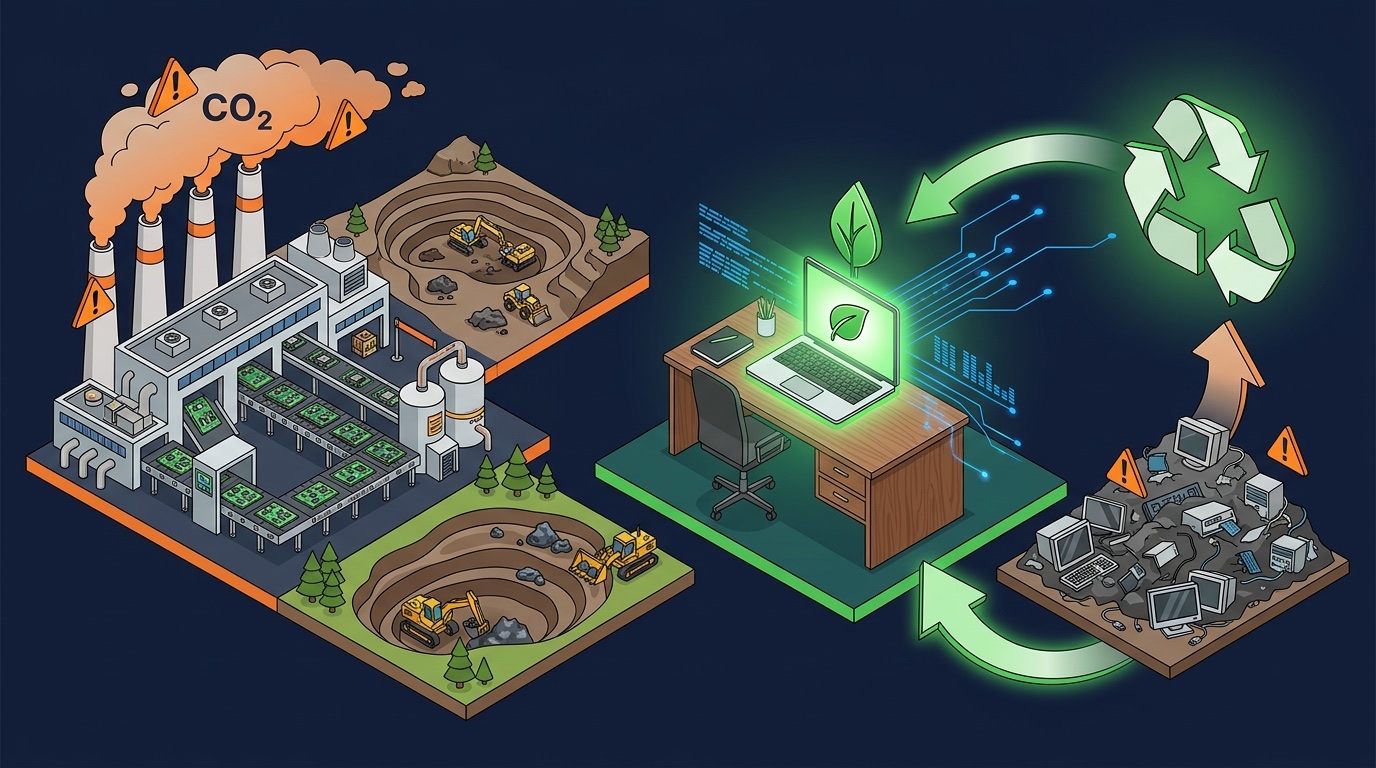
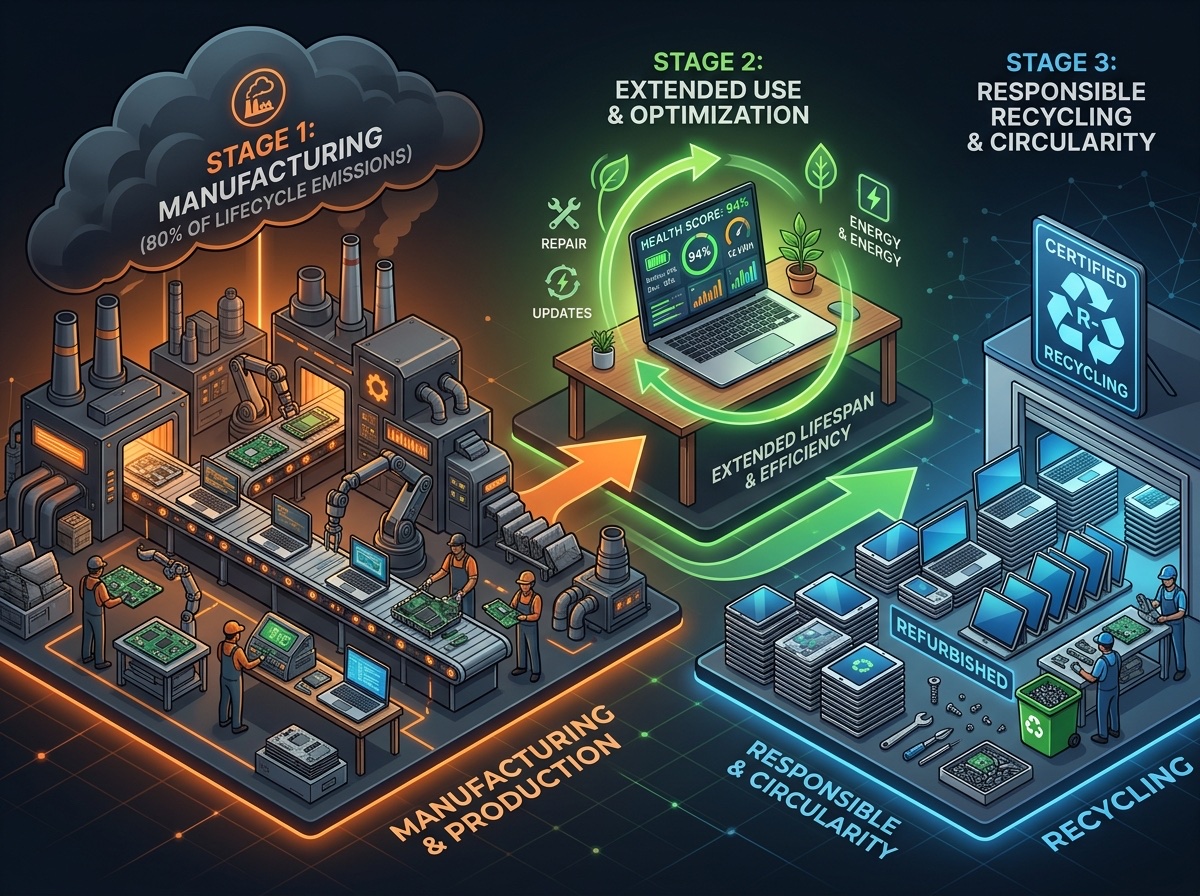
The discipline operates across three dimensions. First, embodied carbon: the emissions generated during manufacturing, from raw material extraction through assembly. Second, operational carbon: the energy consumed during the use phase. Third, end-of-life impact: electronic waste, recycling rates, and disposal.
The evolution has been significant. In the 2010s, sustainable IT was largely a greenwashing exercise — corporate slide decks with leaf icons. By 2025, it is a regulatory framework. The EU's CSRD, France's REEN law, and similar legislation across member states have transformed the field from a PR exercise into an auditable obligation.
Why does sustainable IT start with the physical fleet? Because end-user devices account for 50% of digital carbon emissions (ADEME-Arcep, 2025). Not software. Not the cloud. Hardware.
What is the real environmental impact of IT hardware?
According to the ADEME-Arcep study (January 2025), digital technology accounts for 4.4% of national carbon emissions in Europe's second-largest economy. The critical figure for IT leaders: 50% of that footprint comes from end-user devices — laptops, desktops, and smartphones.
The ADEME-Arcep (2025) study — the most comprehensive European analysis of digital environmental impact — attributes 50% of digital carbon emissions to end-user devices. Within those devices, 78-80% of a laptop's total lifecycle emissions are concentrated in the manufacturing phase, before first use (Oxford IT/Dell, 2023).
78-80%of a laptop's emissions come from manufacturingOxford IT / Dell, 2023
Within those devices, the split between lifecycle phases is stark. Manufacturing accounts for roughly 60% of device emissions and usage for about 40%. But zoom in on laptops specifically, and the ratio gets more extreme: 78 to 80% of a laptop's total greenhouse gas emissions occur during manufacturing (Oxford IT / Dell, 2023). The silicon, the rare earth minerals, the assembly, the shipping — all before the device is ever turned on.
The global e-waste picture compounds this. The UN Global E-Waste Monitor (2024) reports 62 million tonnes of electronic waste generated annually worldwide, projected to reach 82 million tonnes by 2030. Only 22.3% is properly recycled. The rest ends up in landfills, informal recycling operations, or incineration — releasing toxins and wasting recoverable materials.
On the energy side, the gap between device types matters for fleet planning. A laptop consumes approximately 75 kWh per year, while a desktop averages 194 kWh per year (US DOE, 2023). That is a 2.6x difference. For a fleet migrating even 100 desktops to laptops, the annual energy savings reach roughly 11,900 kWh.
Why is your IT fleet the #1 lever for carbon reduction?
If 50% of digital emissions come from end-user devices and 78% of a laptop's footprint is locked in at manufacturing, then the most powerful sustainability action is not turning off screens at night. It is extending the lifespan of your equipment.
Extending a laptop's lifespan from 3 to 6 years reduces its annual carbon emissions by 47% — from 88.9 kg to 47 kg CO2 per year (TCO Certified, 2024). This single action outweighs all eco-gestures combined, because 78% of emissions are already embedded at manufacturing.
-47%annual emissions when extending from 3 to 6 yearsTCO Certified, 2024
The math is straightforward. A laptop that generates 267 kg of CO2 across its lifecycle, used for 3 years, produces 88.9 kg of CO2 per year. Extend that same laptop to 6 years, and the annual figure drops to 47 kg — a 47% reduction (TCO Certified, 2024).
Even a single extra year makes a difference. Extending from 3 to 4 years cuts annual emissions by 25% (Computerworld/EY, 2023). That is an achievable target for any fleet. No hardware upgrade required. No new procurement. Just one more year.
Refurbishment takes the impact further. A refurbished laptop produces only 6.34% of the emissions of a new one (Circular Computing, 2023). That is not a marginal improvement. It is a 94% reduction.
Why do eco-gestures fall short? Turning off a laptop overnight saves roughly 10 kWh per year. Meanwhile, avoiding the purchase of a single new device saves over 300 kg of CO2. The orders of magnitude are not comparable.
Scale this to a fleet. For 500 devices, extending average lifespan by one year avoids replacing approximately 125 machines annually — roughly 40 tonnes of CO2 and over $100,000 in CAPEX. Four out of five executives confirm that sustainability initiatives help reduce operational costs (Gartner, 2024).
What do CSRD and EU sustainability regulations require from IT leaders in 2026?
The EU's Corporate Sustainability Reporting Directive (CSRD) is the regulatory framework that changes everything for IT departments. Rolling out from 2024 through 2029, it requires standardized ESG reporting — including Scope 3 emissions, which encompass your IT fleet's embodied carbon. Large listed companies are already reporting. Large non-listed companies follow in 2028. Listed SMEs in 2029.
The CSRD requires standardized ESG reporting that includes Scope 3 emissions — covering the embodied carbon of IT hardware. Large non-listed companies must comply by 2028. The directive demands data, not intentions: if you cannot measure your fleet's energy consumption, you cannot report it.
In parallel, several EU member states have enacted national digital sustainability legislation. France's REEN law (2021), for instance, requires municipalities above 50,000 inhabitants and large enterprises to implement a digital carbon reduction strategy — including audits, 3-year action plans, and a durability index for devices (effective January 2026). This type of legislation is spreading across the EU as a regulatory trend, with similar frameworks under discussion in Germany, Spain, and the Netherlands.
The practical overlap matters. The same data — energy consumption per device, fleet CO2 footprint, average device lifespan, end-of-life recycling rates — serves both CSRD reporting and national compliance frameworks. Collecting it once satisfies multiple obligations.
What does the IT department need to prepare? Four data streams: real kWh consumption per device, fleet-level CO2 calculations (embodied + operational), device lifespan tracking with replacement justification, and end-of-life documentation (WEEE compliance, recycling rates, refurbishment records).
What are the 7 best practices for a sustainable IT fleet?
Sustainable fleet management best practices break down into 7 concrete actions, ranked by impact: extend first, optimize second, measure third.
The seven sustainable IT best practices for fleet management, ranked by carbon impact: (1) extend device lifespan, (2) prioritize refurbishment, (3) right-size to actual needs, (4) migrate desktops to laptops, (5) enforce power management, (6) measure real energy consumption, (7) report and track continuously.
Action 1: Extend device lifespan
This is the single most powerful lever. Extending from 3 to 5-6 years reduces annual emissions by up to 47% (TCO Certified, 2024). Before replacing, upgrade: a RAM expansion or SSD swap costs $100-300 and adds 2-3 years of productive life.
Action 2: Prioritize refurbishment
A refurbished laptop generates just 6.34% of the emissions of a new device (Circular Computing, 2023). Integrate refurbished options into procurement policy. Internal reallocation — reassigning a capable device to a less demanding role — is even more effective because it eliminates shipping and processing emissions.
Action 3: Right-size to actual needs
Not every employee needs an i7 with 32 GB of RAM. Match hardware specifications to usage profiles. An office worker running email, browsers, and spreadsheets does not need the same machine as a developer compiling code.
Action 4: Migrate desktops to laptops where possible
A laptop consumes approximately 75 kWh per year versus 194 kWh for a desktop (US DOE, 2023). Each migration saves roughly 120 kWh annually. Across a fleet, the cumulative energy savings are substantial — and the flexibility gains for hybrid work are a bonus.
Action 5: Enforce power management
Configure sleep policies, scheduled shutdowns, and hibernation modes fleet-wide. The per-device impact is modest — roughly 10-15 kWh per year. But at scale, it compounds. Power management is the easiest win to deploy across an entire fleet.
Action 6: Organize end of life
Only 22.3% of e-waste is properly recycled globally (UN E-Waste Monitor, 2024). Establish WEEE-compliant collection processes. Prioritize internal refurbishment, then certified recycling partners. The margin for improvement is massive.
Action 7: Measure in real-time and report
None of the above works without measurement. Track real kWh per device — not industry averages. Generate CO2 dashboards at fleet level. Produce quarterly reports that are CSRD-ready. Measurement is the foundation of any credible sustainable IT strategy.
How do you measure the real carbon footprint of your fleet?
Most digital carbon audits rely on industry averages: X kWh per laptop per year. The problem: a 2020 Dell Latitude used 8 hours a day does not consume the same energy as a MacBook Air M3 used 4 hours. For a credible sustainability strategy, you need to measure — not estimate.
The standard approach to IT carbon auditing uses industry average consumption factors — typically 75 kWh/year for laptops (US DOE, 2023). But real per-device measurement reveals a typical gap of 20-40% between estimated and actual consumption, with individual devices ranging from 30 to 300 kWh annually.
Method 1: Emission factor estimates. This is the default approach. Take the number of devices, multiply by an industry average (75 kWh/laptop, 194 kWh/desktop), apply a grid emission factor (varies by country — from ~30g CO2/kWh in France's nuclear-heavy mix to ~400g in coal-dependent grids). It is fast. It is inexpensive. And it is imprecise.
Method 2: Real kWh measurement per device. An endpoint agent installed on each device reports actual energy consumption — factoring in hardware model, usage patterns, uptime, and workload. This approach reveals which devices consume the most, which usage profiles drive consumption, and which devices are candidates for extension versus replacement.
The gap between methods matters. Across monitored fleets, the delta between estimated and measured consumption typically runs 20-40%. Estimates tend to overcount modern laptops (whose M-series or Intel 13th/14th gen chips are remarkably efficient) and undercount legacy desktops running outdated hardware under heavy loads.
Converting kWh to CO2 requires the grid emission factor for your operating region. This varies dramatically: approximately 30-50g CO2/kWh in France or Sweden (nuclear/hydro), 200-300g in the UK or Spain, and 350-450g in Germany or Poland. The same fleet consuming the same kWh produces radically different carbon figures depending on location.
The virtuous cycle: measure per-device consumption, identify the highest-impact levers (extension, replacement, reallocation, migration to laptops), act on them, then measure again to validate the reduction. Continuous measurement turns sustainable IT from a one-time audit into an operational discipline.
What ROI can you expect from a sustainable IT strategy?
Sustainable IT is not a cost center — it is a cost-reduction lever. Four out of five executives say sustainability initiatives help reduce operational costs (Gartner, 2024). The savings come from three sources: lifespan extension, energy optimization, and proactive compliance.
Four out of five executives confirm that sustainability reduces operational costs (Gartner, 2024). For a fleet of 500 laptops, extending average lifespan by one year avoids ~125 replacements, saving approximately 40 tonnes of CO2 and over $100,000 in CAPEX annually.
4 in 5executives say sustainability reduces operational costsGartner, 2024
CAPEX reduction. Extending from 3 to 5 years means replacing 20% of your fleet per year instead of 33%. For a 500-device fleet at $1,200 per device, that is $80,000 in avoided CAPEX annually. Factor in deployment costs (imaging, configuration, data migration), and the real savings are closer to $120,000-150,000.
Energy savings. Identifying over-specced desktops and migrating to laptops saves approximately 120 kWh per device per year. Right-sizing hardware specifications to usage profiles prevents over-procurement. Real-time consumption data reveals the 15-20% of devices that account for disproportionate energy use.
Compliance risk avoidance. The CSRD's procurement exclusion criteria are already affecting public tenders in several EU member states. Organizations that can demonstrate measured environmental impact gain competitive advantage in public and private procurement. Those that cannot are increasingly locked out.
Employer brand. Sustainability credentials are a recruitment asset. In candidate-driven markets, demonstrated sustainability commitments influence hiring — particularly for younger technical talent.
The sustainable IT services market is growing at 19.48% CAGR (Mordor Intelligence, 2025). Organizations that build measurement capability now will lead the market. Those that wait will scramble to comply.
FAQ
What is Green IT?
Green IT refers to the set of practices aimed at reducing the environmental impact of information technology — specifically energy consumption, carbon emissions, and electronic waste. It covers three lifecycle phases: manufacturing (embodied carbon, typically 78-80% of a laptop's total emissions), usage (operational carbon), and end of life (e-waste). In 2026, the market is valued at $38.86 billion (Mordor Intelligence) and the discipline is regulated through the EU's CSRD and national legislation.
What is the fastest way to reduce my IT fleet's carbon footprint?
Extend device lifespan. Going from a 3-year to a 6-year refresh cycle cuts annual emissions per device by 47% (TCO Certified, 2024). Even one additional year reduces emissions by 25% (Computerworld/EY, 2023). This outperforms all other sustainability measures combined, because 78% of a laptop's emissions are locked in at manufacturing. Before replacing, consider RAM or SSD upgrades, which cost $100-300 and add 2-3 years of usable life.
How do I measure the carbon footprint of my IT fleet?
Two approaches exist. The standard method uses industry average emission factors — approximately 75 kWh/year per laptop (US DOE, 2023) — multiplied by your grid's CO2 intensity. It is fast but imprecise. The advanced method uses per-device kWh measurement through an endpoint agent, which captures actual consumption based on hardware model, usage patterns, and workload. The gap between estimated and measured values typically runs 20-40%. sobrii's Green IT module provides per-device measurement.
Is refurbishment genuinely better for the environment?
Yes. A refurbished laptop produces only 6.34% of the CO2 emissions of a new device (Circular Computing, 2023) — a 94% reduction. Internal reallocation (reassigning a capable device to a less demanding role within your organization) is even more effective because it eliminates shipping and industrial reprocessing emissions. With only 22.3% of global e-waste properly recycled (UN E-Waste Monitor, 2024), extending device use through refurbishment is one of the most impactful environmental actions available to IT departments.
Does sustainable IT increase or reduce the IT budget?
It reduces it. Extending the refresh cycle from 3 to 5 years cuts hardware CAPEX by roughly 40%. Migrating a desktop to a laptop saves ~120 kWh/year in energy costs. Proactive CSRD compliance avoids procurement exclusion risk. Four out of five executives confirm that sustainability initiatives reduce operational costs (Gartner, 2024). The sustainability investment — primarily in measurement tools and process changes — typically pays back within 6 months through avoided replacements alone.
Conclusion
The numbers tell a clear story:
4.4% of national carbon emissions come from digital technology — and 50% of that comes from end-user devices (ADEME-Arcep, 2025).
78-80% of a laptop's emissions are embedded at manufacturing (Oxford IT/Dell, 2023). Every additional year of use dilutes that initial impact.
Extending from 3 to 6 years cuts annual emissions by 47% (TCO Certified, 2024). Even one extra year delivers a 25% reduction.
The CSRD demands measurement and reporting — not intentions. The data you collect from your fleet serves both EU-wide and national compliance frameworks.
Real kWh measurement per device, not industry averages, is what separates credible sustainability from greenwashing.
Green IT starts with data. Not awareness campaigns. Not eco-gestures. Data — measured at the device level, tracked over time, and converted into actionable decisions about extension, reallocation, replacement, and procurement.
Arthur is CPO and co-founder of sobrii, a SaaS platform that helps IT leaders manage the lifespan, costs, and carbon footprint of their device fleets. sobrii collects real-time data from every endpoint to replace calendar-based refresh cycles with decisions based on actual machine health.