Shadow IT: How to Detect and Control It in 2026
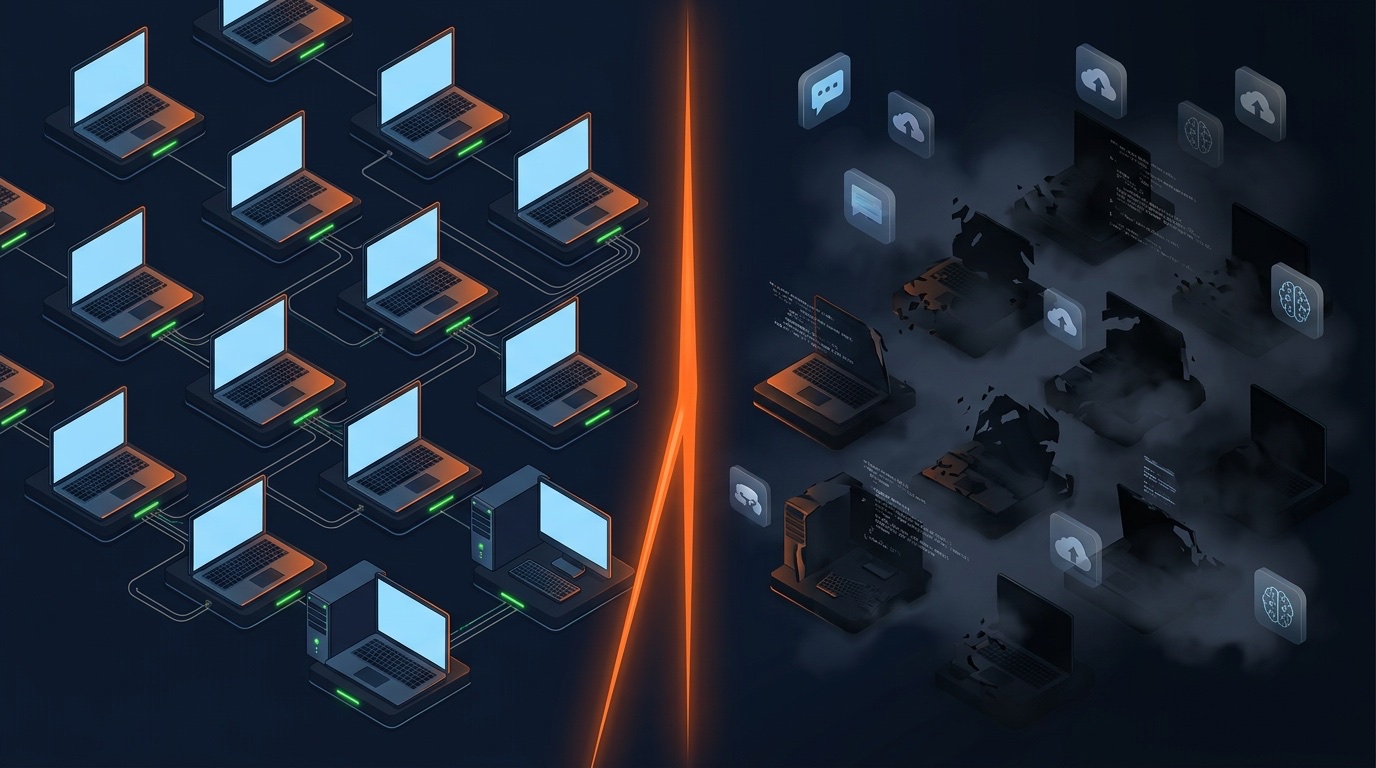
By 2027, 75% of employees will acquire technology outside IT's visibility — up from 41% in 2022 (Gartner, 2023). This isn't a forecast anymore. With generative AI searches for "shadow AI" up 2,438% year-over-year, the shift already happened.
Shadow IT is no longer a security footnote. It drains 30-40% of IT budgets, triggers GDPR violations, and creates blind spots that cost an average of $670,000 extra per breach when AI tools are involved. Yet most detection guides start at the software layer — missing the root cause entirely.
This guide covers the definition, real costs, quantified risks, and a 5-step detection method that starts where nobody else looks: the physical fleet. Plus a decision framework for every shadow tool you find — absorb, block, or replace.
TL;DR: By 2027, 75% of employees will acquire technology outside IT's visibility — up from 41% in 2022 (Gartner). Shadow IT is no longer just rogue spreadsheets on Dropbox: 91% of AI tools operate outside IT control, and shadow AI adds $670K per data breach (IBM, 2025). This guide covers the definition, quantified risks, and a 5-step method to detect and manage shadow IT — starting with visibility over your physical fleet.
Citation capsule
- By 2027, 75% of employees will acquire technology outside IT's visibility, up from 41% in 2022 (Source: Gartner, 2023).
- 91% of enterprise AI tools operate outside IT control, with 269 shadow AI apps per 1,000 employees (Source: Reco, 2025).
- Shadow AI adds $670,000 per data breach, pushing the average cost to $4.63 million (Source: IBM Cost of Data Breach, 2025).
What is shadow IT (and shadow AI)?
91% of AI tools in the enterprise operate outside IT control, with 269 shadow AI applications per 1,000 employees (Reco, 2025). Shadow IT has evolved from a nuisance into the default way employees adopt technology.
Shadow IT refers to any technology — hardware, software, or cloud service — used by employees without the knowledge or approval of the IT department. It includes personal laptops on the corporate network, unsanctioned SaaS subscriptions, browser extensions with corporate data access, and free AI tools processing confidential information.
The term has been around since the early 2000s. What changed is the scale and speed. In 2005, shadow IT meant a USB drive with an unauthorized copy of a database. By 2015, it meant a marketing team running its own Salesforce instance. In 2026, it means an employee pasting customer records into ChatGPT Free during a lunch break.
Shadow AI is the newest and fastest-growing subset. It covers any AI-powered tool used without IT governance — from free-tier large language models to AI coding assistants, image generators, and meeting transcription bots. The numbers are staggering: 49% of employees use AI tools not sanctioned by their employer, and 58% of those use free versions with zero enterprise data protections (BlackFog/Sapio, 2026).
Not all shadow IT is deliberate. Some employees genuinely don't know that signing up for a free SaaS tool violates policy. Others know — and do it anyway because the approved alternative is worse or doesn't exist. Both cases produce the same outcome: data flowing through channels IT cannot monitor, secure, or audit.
Shadow IT is any technology — hardware, software, or cloud service — used without IT department approval. In 2026, shadow AI dominates: 91% of AI tools operate outside IT control, with 269 shadow AI apps per 1,000 employees (Reco, 2025). 58% of users rely on free versions with zero data protections (BlackFog/Sapio, 2026).
Why is shadow IT exploding in 2026?
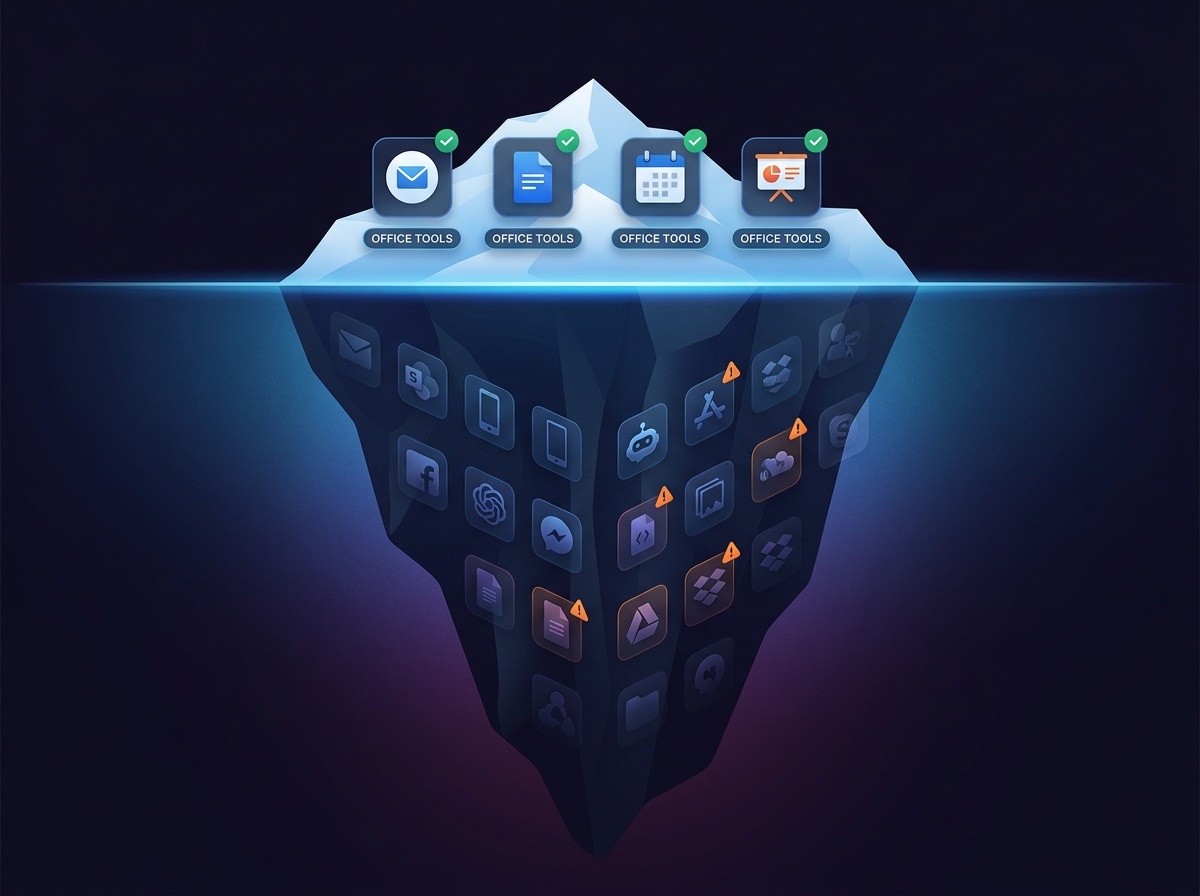
60% of employees say the productivity gains from unsanctioned AI tools are worth the security risk (BlackFog/Sapio, 2026). Shadow IT is not a malice problem. It's a friction problem.
The root cause is a mismatch between IT procurement timelines and tool availability. An employee can sign up for an AI writing assistant in 30 seconds. Getting an equivalent tool approved through IT takes weeks — sometimes months. Faced with that gap, people take the path of least resistance.
Generative AI accelerated the trend dramatically. Roughly 700 new AI applications entered enterprise environments in a single year, and 26 of the top 50 shadow IT apps discovered are pure AI tools (Torii, 2026). Shadow generative AI usage surged 68% year-over-year across enterprises (Menlo Security, 2025). The supply side is flooding the market faster than governance can respond.
Hybrid work poured fuel on the fire. Personal devices on home networks, unmanaged BYOD setups, browser-based tools that bypass VPN — the perimeter dissolved. When every employee's home office is an extension of the corporate network, every personal device becomes a potential shadow IT vector.
The numbers tell a consistent story: 49% of employees use AI tools not sanctioned by their employer, 58% on free versions (BlackFog/Sapio, 2026). And across the broader SaaS landscape, 61.3% of all discovered SaaS applications qualify as shadow IT (Torii, 2026). The majority of your software footprint is invisible to IT by default.
Employees aren't doing this to cause harm. They're doing it because the approved toolset doesn't keep up.
Shadow IT explodes in 2026 because AI tools are free and instant while IT approval takes weeks. 60% of employees accept the security risk (BlackFog/Sapio, 2026). 700 new AI apps entered enterprises in one year, and shadow AI usage surged 68% YoY (Menlo Security, 2025).
How much does shadow IT really cost?
Shadow IT accounts for 30-40% of total enterprise IT spending (Gartner/Everest Group, 2025). But the biggest line item isn't wasted licenses — it's the bill when something goes wrong: shadow AI adds $670,000 per breach, pushing the average cost to $4.63 million (IBM, 2025).
The cost breaks down into four layers.
License waste. Unsanctioned SaaS subscriptions purchased on corporate credit cards, expensed individually, never negotiated at enterprise rates. Duplicate tools doing the same job across departments. Free-tier tools that upgrade to paid plans without IT visibility. These add up to hundreds of thousands in mid-size organizations — money that could fund approved alternatives.
Budget leakage. When 30-40% of IT spending happens outside the IT budget, forecasting becomes fiction. You can't optimize what you can't see. Renewal negotiations, volume discounts, vendor consolidation — all impossible when procurement doesn't know half the tools in play.
Breach costs. One in five organizations reported a data breach caused by shadow AI in 2025 (IBM, 2025). The $670K adder reflects the extra complexity: data scattered across unmonitored tools, incident response teams scrambling to identify what was exposed, longer containment times. When 97% of organizations that suffered AI-related breaches lacked proper access controls, the pattern is systemic.
Regulatory fines. GDPR penalties reach up to 4% of global annual revenue or EUR 20 million — whichever is higher. Shadow IT makes compliance violations almost inevitable: unregistered data processors, missing data processing agreements, personal data flowing to servers with unknown jurisdictions.
| Cost layer | Representative value | Source |
|---|---|---|
| License waste | $150-300K per mid-size enterprise | Flexera, 2025 |
| Budget leakage | 30-40% of total IT spend | Gartner/Everest Group, 2025 |
| Breach cost (AI) | +$670K per breach | IBM, 2025 |
| Regulatory fines | Up to 4% of global revenue | GDPR |
For a 200-employee organization with a $1M IT budget, 30-40% shadow IT exposure means $300-400K in uncontrolled spending annually — before any breach occurs. Most of that spend is invisible until someone runs a full fleet and application audit. The breach multiplier turns a budget problem into an existential one.
Shadow IT consumes 30-40% of enterprise IT budgets (Gartner/Everest Group, 2025). Shadow AI adds $670,000 per breach, pushing total cost to $4.63 million (IBM, 2025). One in five organizations reported a shadow AI breach — 97% lacked proper access controls.
What are the real risks of shadow IT?
97% of organizations that suffered an AI-related breach lacked proper access controls (IBM, 2025). Shadow IT turns every employee into a potential attack vector — not through intent, but through invisible gaps in governance.
Security risk. Unsanctioned applications don't receive centralized patch management. No MFA enforcement. No endpoint detection. No logging. Data sits on servers that IT has never vetted, in jurisdictions IT has never verified. Every unmonitored tool is an entry point an attacker can exploit.
Compliance risk. Under GDPR, every tool that processes personal data must be documented in the processing register (Article 30), secured to appropriate standards (Article 32), and covered by a Data Processing Agreement if operated by a third party. Shadow IT makes all three impossible. If an employee uses an unregistered AI tool to summarize customer emails, the organization is technically in violation — regardless of the employee's intent.
Operational risk. Data trapped in shadow tools creates silos. No backups. No business continuity plan. When the employee who managed the team's Notion workspace leaves, the data either goes with them or sits orphaned in an account no one controls. Handoff becomes impossible.
Intellectual property risk. 65% of shadow AI breaches involved customer PII, and 40% led to intellectual property theft (IBM, 2025). Employees pasting proprietary code into AI tools, uploading product specs to free design platforms, sharing financial models via personal cloud storage — each action creates an exposure path.
Device-level risk. Here's the angle most guides miss: a device that doesn't appear in your IT asset inventory is a device where every application is shadow IT by definition. A personal laptop connected to the corporate Wi-Fi — running unpatched software, no disk encryption, no managed antivirus — is not just one shadow tool. It's an entire shadow environment. Shadow IT detection must start at the hardware layer. You cannot discover rogue software on rogue hardware.
Shadow IT creates five risk categories: security, compliance, operational, intellectual property, and device-level. 40% of shadow AI breaches led to IP theft (IBM, 2025). Unmanaged hardware makes every installed app shadow IT by default. 97% of AI-breached organizations lacked proper access controls.
How to detect shadow IT in your fleet

Detection starts with a truth most guides ignore: you cannot find rogue software on rogue hardware. The first step isn't a CASB — it's a complete inventory of every connected device. 61.3% of all discovered SaaS applications qualify as shadow IT (Torii, 2026). But you'll only find them if you first know what machines to scan.
Here's the 5-step detection method.
Step 1 — Inventory all hardware
Discover every device connected to your network — including those not enrolled in Active Directory or your MDM. Traditional discovery tools miss devices that bypass domain join: personal laptops, contractor machines, IoT endpoints. An endpoint agent that doesn't depend on AD enrollment catches what others miss.
When sobrii's Rust-based endpoint agent is deployed across a fleet, 10-15% of discovered devices are typically unknown to IT — machines that never appeared in the CMDB, MDM, or AD. Every application on those devices is unmanaged by definition. A complete IT asset inventory is the non-negotiable foundation.
Step 2 — Map all applications
Scan every inventoried device for installed software. Compare against the approved application catalog. Flag everything that doesn't match. This includes desktop applications, browser extensions, local AI tools, and portable apps that don't require installation. The gap between "approved catalog" and "what's actually installed" is your shadow IT surface area.
Step 3 — Audit network traffic
Analyze outbound connections to identify SaaS services accessed from corporate endpoints. CASB solutions, proxy logs, and DNS analytics reveal which cloud services employees connect to — even if nothing was installed locally. Browser-based AI tools (ChatGPT, Claude, Gemini) show up here.
Step 4 — Cross-reference expenses
Reconcile SaaS invoices and credit card statements with the application inventory. Any subscription being paid for but not appearing in the IT catalog is shadow IT. Conversely, any tool in active use with no corresponding license may indicate free-tier or trial usage — a compliance risk in its own right.
Step 5 — Classify and prioritize
Not all shadow IT requires the same response. Use the Absorb/Block/Replace framework (covered in the next section) to triage every discovery. High data sensitivity + no approved alternative = immediate action. Low-risk productivity tool + strong adoption = candidate for absorption into the catalog.
Of the top 50 shadow IT applications discovered in enterprise environments, 26 are pure AI tools (Torii, 2026). The detection method must account for this reality. Traditional software asset management catalogs don't include AI tools because they didn't exist two years ago. Update the catalog, or the audit misses half the problem.
Shadow IT detection follows five steps: inventory hardware, map applications, audit network traffic, cross-reference expenses, and classify via Absorb/Block/Replace. 61.3% of discovered SaaS apps qualify as shadow IT (Torii, 2026), and 26 of the top 50 are pure AI tools.
Should you block, absorb, or replace shadow IT?
Blocking all shadow IT is just as ineffective as ignoring it: 60% of employees will keep using unsanctioned tools if those tools make them more productive (BlackFog/Sapio, 2026). The right approach is a three-path decision framework.
Absorb
The tool meets a real need, poses acceptable risk, and can be brought under IT governance. Action: negotiate an enterprise license, configure SSO and data controls, deploy centrally, add to the approved catalog. Examples: Notion, Figma, Canva — tools teams adopted because they were better than what IT offered. Legitimize them instead of fighting adoption.
Block
The tool poses unacceptable security or compliance risk, and an approved alternative already exists. Action: restrict access (DNS block, CASB policy), communicate the approved alternative, migrate data. Example: employees using ChatGPT Free to process customer data when an enterprise LLM instance with data loss prevention is available. Blocking without providing an alternative guarantees workarounds.
Replace
The tool meets a real need, but the risk profile is too high to absorb as-is. Action: identify and deploy an approved alternative that covers the same use case, then migrate users. Example: a team using a free AI transcription service for meeting notes — replace with an enterprise-grade tool that keeps data within your jurisdiction.
Decision criteria. Four factors determine the path: (1) sensitivity of the data involved, (2) whether an approved alternative exists, (3) migration cost and complexity, (4) current user adoption level. High data sensitivity with no alternative demands urgent action. Low data sensitivity with high adoption is a strong absorb candidate.
The shadow AI case proves the point. "Block ChatGPT" as a policy doesn't work when 60% of employees consider the productivity gain worth the risk. Deploy an enterprise instance with DLP, audit logging, and access controls instead. Meet the demand with a governed solution.
The Absorb/Block/Replace framework goes beyond the usual "block it" or "write a policy" advice. Neither works when 700 new AI apps enter the enterprise every year. A structured decision tree that accounts for data sensitivity, alternatives, and adoption gives IT leaders a repeatable process.
Use application mapping tools to maintain an up-to-date view of what's installed across the fleet and feed the classification process.
Blocking all shadow IT fails — 60% of employees keep using unsanctioned tools regardless (BlackFog/Sapio, 2026). The Absorb/Block/Replace framework triages each tool by data sensitivity, alternative availability, migration cost, and adoption level. Absorb safe tools, block high-risk ones with alternatives, replace those that serve real needs but carry too much risk.
How to build a sustainable shadow IT policy
By 2027, 75% of employees will acquire technology outside IT's visibility (Gartner, 2023). The trend is structural — not reversible. Your response must be systemic, not reactive.
A sustainable policy lives in tooling, not in a PDF document nobody reads. Four pillars hold it together.
Pillar 1: Continuous visibility. Automated inventory of all hardware and software, updated in real time. Not once a year. Not once a quarter. Every device, every application, every change — captured the moment it happens. An endpoint agent is the mechanism. The sobrii platform detects shadow IT through field-level data collection across every endpoint.
Pillar 2: Approved catalog. A curated, accessible list of approved tools — organized by category (messaging, storage, AI, design, analytics). Updated regularly. With approved alternatives for every major category so employees never hit a dead end. If the catalog is stale or incomplete, employees fill the gap themselves.
Pillar 3: Fast adoption process. If an employee requests a new tool, respond within 48 hours. A two-week review cycle for a SaaS app that takes 30 seconds to sign up for is the single biggest driver of shadow IT. Speed kills shadow IT faster than any technical control. Not every request gets approved — but every request gets a fast, clear answer.
Pillar 4: Automated monitoring. Alerts on newly detected applications. Monthly review of uncataloged software. Quarterly reporting to leadership. The monitoring loop feeds back into the Absorb/Block/Replace classification. New discovery? Triage it. Trending adoption of an unapproved tool? Evaluate it before it spreads.
Training matters, but framing matters more. Don't blame employees for using shadow IT. Explain the risks — data exposure, compliance, IP loss — and make the approved path easier than the shadow path. Awareness without friction reduction is theater.
A sustainable shadow IT policy has four pillars: continuous visibility, an approved tool catalog, a fast adoption process (48-hour response), and automated monitoring. The policy must live in tooling — by 2027, 75% of employees will acquire tech outside IT visibility regardless (Gartner, 2023).
Shadow IT and GDPR: what are your obligations in 2026?
65% of shadow AI breaches involved customer personally identifiable information (IBM, 2025). When shadow IT processes personal data, GDPR compliance fails by default — regardless of employee intent.
Article 30 — Processing register. GDPR requires organizations to maintain a register of all data processing activities. If a tool isn't in your IT inventory, it can't be in your processing register. Every shadow SaaS tool that handles personal data is an unregistered processing activity — a direct violation.
Article 32 — Security of processing. Organizations must implement appropriate technical measures to secure personal data. An unsanctioned tool has no security guarantees from the organization's perspective: no penetration testing, no encryption verification, no incident response procedure. The security obligation is unmet by definition.
Unregistered sub-processors. Under GDPR, every third-party tool that processes personal data on your behalf is a sub-processor that requires a Data Processing Agreement (DPA). Shadow SaaS tools are sub-processors without DPAs. If a breach occurs through one of these tools, the organization bears full liability.
The AI-specific problem. When an employee pastes customer data into a free-tier AI tool, that data may be processed on servers outside the EU, used for model training, and retained indefinitely. This constitutes a potential cross-border data transfer without adequate safeguards — another GDPR violation.
The penalty exposure. Fines reach up to 4% of global annual revenue or EUR 20 million, whichever is higher. For a company with EUR 50M in revenue, that's a EUR 2M maximum penalty from a single shadow IT incident. The reputational damage is often worse than the fine itself.
Under GDPR, shadow IT creates automatic compliance failures: Article 30 requires a processing register, Article 32 demands security measures unsanctioned tools lack, and every shadow SaaS tool is an unregistered sub-processor. 65% of shadow AI breaches involve customer PII (IBM, 2025). Fines reach 4% of global revenue or EUR 20 million.
FAQ
Is shadow IT always dangerous?
No. Shadow IT often reveals genuine needs that IT hasn't addressed. 60% of employees use unsanctioned tools because those tools make them more productive (BlackFog/Sapio, 2026). The goal is not to block everything — it's to detect, evaluate, and decide: absorb the tool into the approved catalog, block it if the risk is unacceptable and an alternative exists, or replace it with a governed equivalent. Shadow IT becomes dangerous when it goes undetected — not when it exists.
How do I detect shadow AI in my organization?
Start with two layers. First, deploy an endpoint agent to scan every device for installed AI applications — including tools that don't require installation (portable apps, browser extensions). Second, audit outbound network traffic to identify browser-based AI services (ChatGPT, Claude, Gemini, Midjourney). 91% of AI tools operate outside IT control (Reco, 2025), so assume the footprint is larger than you think. With application mapping, detection becomes automatic rather than manual.
What is the difference between shadow IT and BYOD?
BYOD (Bring Your Own Device) is an official policy that permits employees to use personal devices under defined rules — enrollment in MDM, compliance requirements, data separation. Shadow IT is unauthorized. A personal laptop used for work without any BYOD policy is shadow IT. The same laptop enrolled in a BYOD program with MDM policies is managed. The difference is governance, not the device itself.
Does shadow IT really cost 30-40% of the IT budget?
Yes. Gartner and the Everest Group (2025) estimate that 30-40% of total enterprise IT spending occurs outside IT's control. This includes individually purchased SaaS subscriptions, duplicate tools across departments, free-tier tools that upgrade to paid plans, and consulting services procured without IT involvement. For an organization with a $1M IT budget, that represents $300-400K in uncontrolled expenditure annually — before accounting for breach costs or compliance penalties.
How do I convince leadership to address shadow IT?
Three data points. First: 30-40% of your IT budget is invisible — that's a governance gap any CFO will take seriously. Second: shadow AI adds $670,000 per data breach (IBM, 2025) — that's a risk the CISO can quantify. Third: unregistered data processors violate GDPR by default — that's a liability the legal team will flag. Propose a fleet and application audit as the first step — a 48-hour exercise, not a six-month project. Start with visibility. Decisions follow. Request a fleet audit to see what your IT inventory is missing.
Shadow IT is not going away. The forces driving it — free AI tools, hybrid work, slow procurement — are structural. The question is whether you detect and govern it, or let it govern you.
Key takeaways:
- Shadow IT accounts for 30-40% of enterprise IT budgets (Gartner/Everest Group, 2025)
- Shadow AI adds $670,000 per data breach (IBM, 2025) — with 91% of AI tools outside IT control
- Detection starts at the hardware layer: unmanaged devices mean unmanaged software
- The Absorb/Block/Replace framework turns discovery into structured decisions
- A sustainable policy requires continuous visibility, an approved catalog, fast adoption, and automated monitoring
- Every unregistered SaaS tool is a potential GDPR violation
The first step is seeing what you currently can't. A complete IT asset inventory is the foundation. From there, the Keep/Repair/Reallocate/Replace framework applies to every device and application you discover.
sobrii gives you visibility across the full fleet — hardware, software, and shadow IT — in 48 hours. Request your fleet audit.
Sources
- Gartner — IT and technology research newsroom. https://www.gartner.com/en/newsroom (accessed 2026-05-05)
- Reco — State of shadow AI in the enterprise, 2025. https://www.reco.ai/ (accessed 2026-05-05)
- IBM — Cost of a Data Breach Report 2025. https://www.ibm.com/reports/data-breach (accessed 2026-05-05)
- BlackFog / Sapio Research — Shadow AI and unsanctioned tool usage, 2026. https://www.blackfog.com/ (accessed 2026-05-05)
- Torii — SaaS Benchmark / shadow IT discovery, 2026. https://www.toriihq.com/ (accessed 2026-05-05)
- Menlo Security — Generative AI usage trends, 2025. https://www.menlosecurity.com/ (accessed 2026-05-05)
- Flexera — State of IT and SaaS spend, 2025. https://www.flexera.com/ (accessed 2026-05-05)
Manage your IT fleet with sobrii
Discover how sobrii transforms IT fleet management.
Book a demo