Green IT
Green IT: Measure and Reduce Your Fleet's Carbon Footprint
78-80% of a laptop's emissions come from manufacturing (Oxford IT, 2023). Green IT guide: 7 actions to measure and cut your IT fleet's environmental impact.
13 min read
By Arthur Teboul, CPO & Co-founder of sobrii — updated May 5, 2026
TL;DR — The EU Corporate Sustainability Reporting Directive (CSRD) requires every mid-market company above 250 employees or €50M revenue to publish an audited sustainability report aligned with the ESRS standards. For the IT department, six concrete fleet metrics are expected: hardware carbon footprint, lifespan extension rate, reuse rate, electricity consumption, average device lifespan, repair rate. This guide breaks them down with sources from Cigref, AMF France, and the French government's portail-rse.
Citation capsule
The CSRD applies in waves since 2024. In 2026, thresholds expanded the scope to all French mid-market companies meeting at least two of three criteria: more than 250 employees, more than €50 million revenue, or more than €25 million in balance sheet assets. The Cigref report on CSRD implementation (January 2026) estimates around 6,000 French mid-market companies are directly in scope this year, with mandatory audited reporting for the current fiscal year.
For IT directors, this is no longer abstract. The CFO and the sustainability team are now requesting hard data on the IT fleet. Without a measurement system, reporting becomes either declarative — which is fragile in audit — or built by hand in Excel for three weeks every December.
The CSRD does not explicitly list "6 IT metrics," but six emerge as the de facto standard across mid-market companies that have already filed sustainability reports for 2024-2025. The synthesis below cross-references the French government ESRS portal, the Cigref CSRD 2026 report, and AMF France's ESRS analysis.
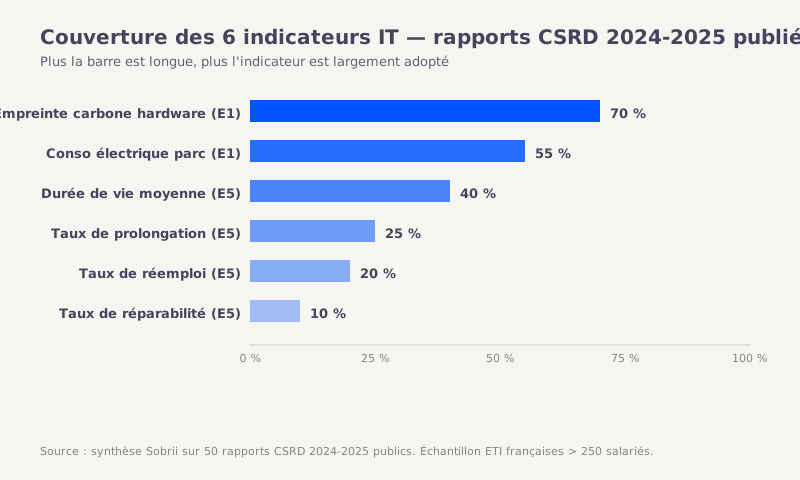
Scope 3 category 11 (use of products sold) and category 1 (purchased goods) cover emissions tied to manufacturing PCs, monitors, and servers. Standard method: ADEME emission factors × hardware volume × amortization period.
Measured in annual kWh, broken down by device type (desktop, laptop, monitor, server, printer). The easiest metric to collect — it already lives in the utility bill if you can attribute the IT share.
Circular economy. A PC moving from 4 to 6 years of service drastically reduces Scope 3 category 11 over time. The number-one improvement lever in the standard.
Percentage of PCs whose service life has been extended beyond the original replacement target. Direct indicator of the "repair before replace" effort.
Percentage of devices leaving the fleet that go to reuse (donation, resale, refurbishment) rather than waste streams. Reference: Responsible IT and CSRD: the IT director's contribution (Grant Thornton, 2024).
Percentage of hardware incidents that resulted in a repair rather than a replacement. Hard to quantify without a tracking tool that records the decisions.
Three methods coexist with sharply different trade-offs in precision and effort. The Cigref CSRD report explicitly distinguishes "declarative," "emission-factor-based," and "source-measured" approaches.
| Method | Precision | Effort | Audit-ready? |
|---|---|---|---|
| Declarative (FTE × sector average) | Low | Very low | No — fragile under audit |
| ADEME emission factors (volume × EF × duration) | Medium | Moderate (needs current inventory) | Yes (recognized method) |
| Source measurement (agent telemetry + lifecycle tracking) | High | High without a dedicated tool | Yes + operational pilot |
For a 500-PC fleet, the ADEME emission factor method is enough for the first reporting year. Beyond that, telemetry becomes necessary if you want to drive the E5 metrics (extension, repair) — those require a per-device trace, not an aggregate average.
The two standards are the most demanding for the IT department. ESRS E1 requires Scope 1 / 2 / 3 emissions quantification, with 3.1 (purchased goods) and 3.11 (use of sold products) covering 80% of an IT fleet's digital footprint. ESRS E5 mandates reporting of inbound and outbound material flows — directly applicable to the IT lifecycle.
According to the Yuzko analysis on CSRD reporting from the IT seat, 70% of mid-market companies start with E1 (climate is the headline) and report E5 partially in year one. Full E5 coverage typically takes 12 to 18 months to mature.
Manual collection breaks past 500 devices. Three tool families address the need with complementary angles:
Field observation: 80% of mid-market companies start by combining MDM with an annual CSV export. Internal collection effort runs 5 to 15 person-days per fiscal year depending on fleet size — a hidden cost CFOs discover in year two of reporting.
sobrii partnered with Montpellier Metropolis on extending the service life of 2,000 PCs, a project that translates directly into ESRS E5 reporting. The work, led with the metropolis's IT department and publicly documented by the Montpellier startup incubator, shows how an operational decision becomes a CSRD indicator:
Exactly the keep, repair or replace logic — applied with data, not by default.
Mid-market companies meeting at least 2 of 3 criteria: > 250 employees, > €50M revenue, > €25M balance sheet. The consolidated group threshold applies: if the parent company is in CSRD scope, subsidiaries automatically contribute to the group report.
Yes for mid-market companies in the 2026 wave. The directive requires reporting on fiscal year 2025 or 2026 depending on the wave — confirm with your statutory auditor, who will certify. Late reporting exposes you to financial sanctions.
Hardware carbon footprint (ESRS E1), fleet electricity consumption (E1), average device lifespan (E5), lifespan extension rate (E5), reuse rate (E5), repair rate (E5). Detailed in the dedicated section above.
The French transposition decree provides administrative fines, suspension of authorization to issue financial instruments for listed companies, and potential civil liability for directors. The most immediate sanction is non-certification by the statutory auditor — which becomes public.
No. sobrii Pilote produces audit-ready IT metrics. A CSRD consultant remains necessary for materiality, sustainability strategy, double materiality analysis, and integrated report drafting. We provide the IT data; you build the narrative.
No. sobrii Pilote is not a certification body. The data the platform produces is auditable (per-device traceability, documented method), but certification remains the responsibility of the client's statutory auditor.
CSRD turns the IT department into a data provider for sustainability reporting. Six metrics emerge as standard: carbon, consumption, lifespan, extension, reuse, repair. MDM tools alone don't cover them — you need an IT pilot layer that crosses inventory, telemetry, emission factors, and lifecycle.
The sobrii narrative aligns with that need: keep, repair or replace, but with audit-defensible data. Stop treating CSRD reporting as an annual 15-day chore.
Book a 20-minute demo at sobrii.io/demo to see how sobrii Pilote outputs the 6 metrics directly. Or start by estimating your carbon baseline with the sobrii TCO Calculator.
For deeper reading: Keep, repair or replace — multi-source TCO synthesis, IT asset inventory guide, Pragmatic IT sustainability for IT directors.
Arthur Teboul is CPO and Co-founder of sobrii. An emlyon business school graduate, he has led product since 2023 and works daily with French mid-market IT directors on CSRD-driven fleet pilot. This article draws on field feedback from sobrii prospects and customers (Montpellier Metropolis, Hérault Logement) and the Tier 1 public sources listed below.
Tier 1 — institutional and government
.gouv.fr.Tier 2-3 — sector analyses
Case study
Discover how sobrii transforms IT fleet management.
Book a demo